USAID DEC
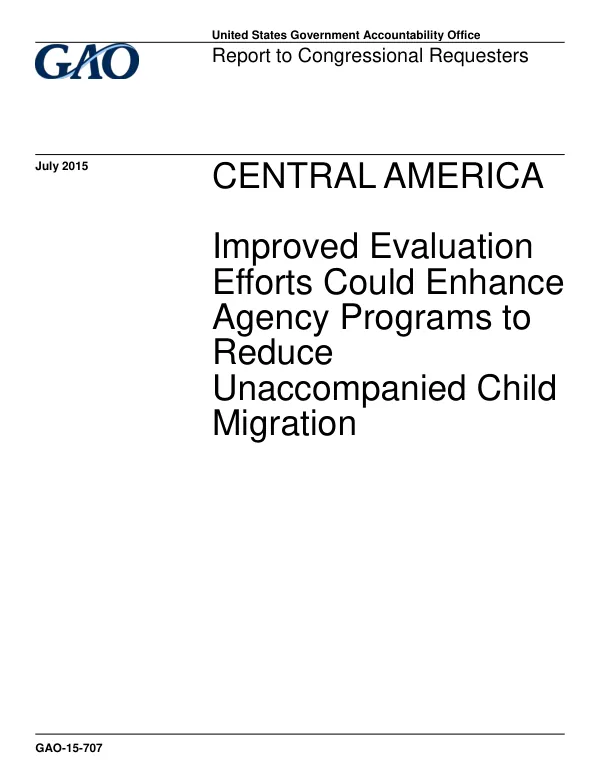
GAO-15-707, CENTRAL AMERICA: Improved Evaluation Efforts Could Enhance Agency Programs to Reduce Unaccompanied Child Migration
Sign inINTER-AMERICAN FOUNDATION
GAO-15-707, CENTRAL AMERICA: Improved Evaluation Efforts Could Enhance Agency Programs to Reduce Unaccompanied Child Migration
The rapid increase in unaccompanied alien child (UAC) migration from Central America has been a significant concern for U.S.
2015 · 84 pages
Sign in to readA free account is required to download.
Abstract
agencies. According to the Department of Homeland Security (DHS), the number of UAC apprehended at the U.S.-Mexican border climbed from nearly 28,000 in fiscal year 2012 to more than 73,000 in fiscal year 2014. The majority of these children were nationals of El Salvador, Guatemala, and Honduras, countries facing extreme violence and persistent poverty. Those who migrate can encounter even more dangers, such as robbery and abuse. U.S. agencies have sought to address the causes of UAC migration through recent programs, including information campaigns to deter migration, developed in response to the migration increase and other long-standing efforts. The recent migration increase was likely triggered by several emergent factors, such as the increased presence and sophistication of human smugglers (known as coyotes) and confusion over U.S. immigration policy. Officials also noted that certain persistent conditions, such as violence and poverty, have worsened in certain countries. In addition to long-standing efforts, such as U.S. Agency for International Development (USAID) antipoverty programs, agencies have taken new actions. For example, DHS-led investigative units have increasingly sought to disrupt human smuggling operations. U.S. agencies have located programs based on various factors, including long-term priorities such as targeting high-poverty and -crime areas. However, they have adjusted to locate more programs in high-migration communities. For example, Department of State (State) officials in Guatemala said they moved programs enhancing police anticrime capabilities into such communities, and USAID officials in El Salvador said they expanded to UAC-migration-affected locations. Most agencies have developed processes to assess the effectiveness of programs seeking to address UAC migration, but weaknesses exist in these processes for some antismuggling programs. The Department of Homeland Security (DHS) has established performance measures, such as arrests, for units combating UAC smuggling, but has not established numeric or other types of targets for these measures, which would enable DHS to measure the units' progress. In addition, DHS and State have not always evaluated information campaigns intended to combat coyote misinformation. DHS launched its 2013 campaign in April, but launched its 2014 campaign in late June after migration levels peaked. Neither agency evaluated its 2014 campaign. Collecting performance information on media campaigns can have value in informing future campaign efforts to reduce child migration. The U.S. Agency for International Development (USAID) has allocated funding for programs in El Salvador, Guatemala, and Honduras, with a focus on addressing the root causes of UAC migration. For example, USAID has provided funding for programs aimed at improving economic opportunities, enhancing education and healthcare, and promoting community development. The Department of State (State) has also allocated funding for programs in these countries, with a focus on addressing the security and economic challenges faced by the region. The report highlights the need for U.S. agencies to integrate evaluations into their planning for, and implementation of, future information campaigns intended to deter migration. The report also recommends that DHS establish performance targets for its investigative units. The Department of Homeland Security (DHS) concurred with both recommendations, and the Department of State (State) concurred with the one recommendation directed to it.
Related documents
Documents in this collection
 2021
2021USAID DEC
Trainer of Virtual Trainers in Human Rights of People with HIV and the LGBTI Population Course Report
Open record 2021
2021USAID DEC