NORC AT THE UNIVERSITY OF CHICAGO
GBVI sub-regional report SUMMARY
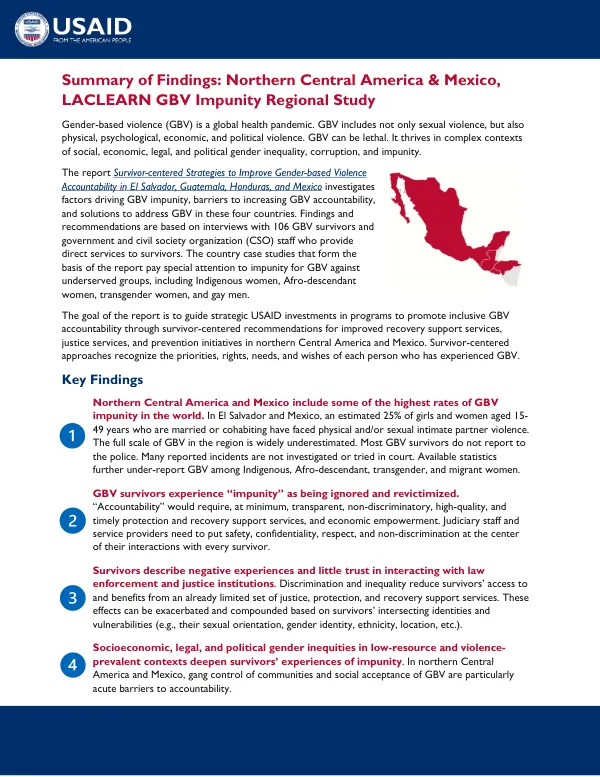
Northern Central America and Mexico have some of the highest rates of gender-based violence (GBV) impunity in the world.
2 pages
Sign in to readA free account is required to download.
Abstract
In El Salvador and Mexico, an estimated 25% of girls and women aged 15-49 years who are married or cohabiting have faced physical and/or sexual intimate partner violence. The full scale of GBV in the region is widely underestimated, with most GBV survivors not reporting to the police. Many reported cases are not investigated or tried in court, and available statistics further under-report GBV among Indigenous, Afro-descendant, transgender, and migrant women. GBV survivors experience impunity as being ignored and revictimized. Accountability would require transparent, non-discriminatory, high-quality, and timely protection and recovery support services, as well as economic empowerment. Survivors describe negative experiences and little trust in interacting with law enforcement and justice institutions. Discrimination and inequality reduce survivors' access to justice, protection, and recovery support services, exacerbating the effects based on survivors' intersecting identities and vulnerabilities. Socioeconomic, legal, and political gender inequities in low-resource and violence-prevalent contexts deepen survivors' experiences of impunity. In northern Central America and Mexico, gang control of communities and social acceptance of GBV are particularly acute barriers to accountability. GBV thrives in complex contexts of social, economic, and political gender inequality, corruption, and impunity. The report identifies four key findings and recommendations to guide strategic USAID investments in programs to promote inclusive GBV accountability. The first approach focuses on GBV survivor-centered protection and recovery support services, including expanding and improving safe and affordable housing for diverse survivors and their dependents, improving survivor-centered procedures for GBV crimes, and increasing CSO funding, technical, and human resources to expand GBV recovery support. The second approach emphasizes GBV survivor-centered justice services, including reforming legal frameworks, developing gender diversity and Indigenous identity, and improving staff training in justice institutions on law implementation. This approach also includes engaging active participation of gender-diverse, Indigenous, and Afro-descendant survivor groups in legal and policy reform and in decision-making processes. The third approach prioritizes GBV survivor-centered prevention initiatives, including identifying structural and community-level risk factors that perpetuate the exclusion and discrimination against underserved survivor groups. This approach also includes investing in campaigns to promote positive, non-violent masculinities and preventing re-offense, recidivism, and cycles of GBV perpetration and impunity. The LAC Bureau has a crucial role in supporting the development and integration of survivor-centered GBV accountability initiatives in the region. Recommendations include coordinating within and across the bureau and other Washington, D.C.-based units, developing terms of reference to engage and recruit full-time Senior GBV Technical Advisors, and translating the Implementation Plan into sector-specific guidance for integrating GBV accountability throughout the Program Cycle.
Related documents
Documents in this collection
 2021
2021USAID DEC
Report of the Trainer of Virtual Trainers in Human Rights of People With HIV and the LGBTI Population Course
Open record 2021
2021USAID DEC