USAID DEC
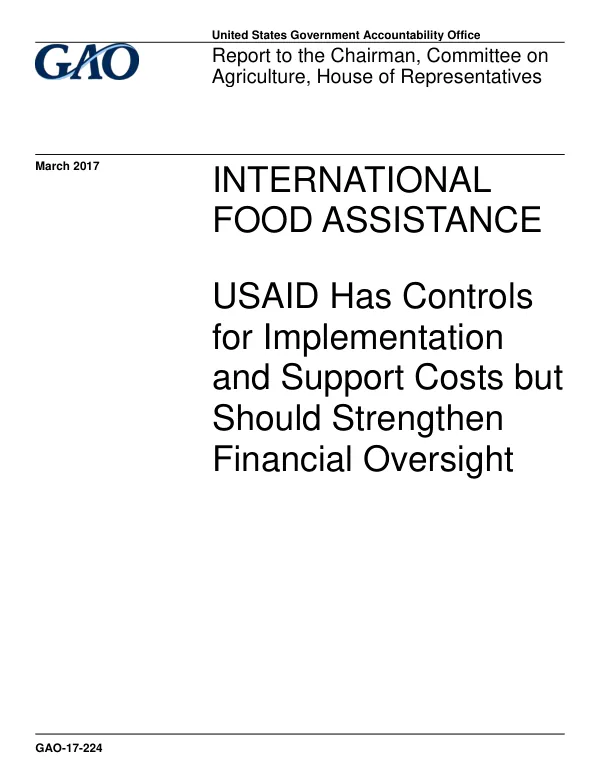
GAO-17-224, INTERNATIONAL FOOD ASSISTANCE: USAID Has Controls for Implementation and Support Costs but Should Strengthen Financial Oversight
Sign inU.S. GOVERNMENT ACCOUNTABILITY OFFICE
GAO-17-224, INTERNATIONAL FOOD ASSISTANCE: USAID Has Controls for Implementation and Support Costs but Should Strengthen Financial Oversight
The U.S.
2017 · 67 pages
Sign in to readA free account is required to download.
Abstract
Agency for International Development (USAID) has used most of the 2014 Farm Bill's increase in authorized funding for section 202(e) of the Food for Peace Act to provide cash transfers, food vouchers, and locally or regionally procured food. These modalities were not previously supported through Title II. Of the additional authorized funding that the agency utilized, USAID obligated 75 percent in fiscal year 2014 and 96 percent in fiscal year 2015 for these modalities. USAID has also increasingly used funds from accounts authorized by the Foreign Assistance Act, along with 202(e) funding, to implement and support projects. In some cases, USAID has used funds from those accounts along with 202(e) funding to provide cash transfers, food vouchers, or local or regional procurement in a single project. This shift in funding utilization presents potential oversight challenges. USAID and its partners have various controls for financial oversight of Title II funding used for implementation and support costs. However, GAO found certain deficiencies in USAID's oversight. USAID reviews partners' detailed planned budgets for these costs and high-level quarterly financial reports, but it generally has not conducted systematic, targeted financial reviews of partners' actual spending on these costs. Partners' internal controls generally included policies and procedures to help ensure proper use of funds. However, GAO's limited, nongeneralizable financial transactions testing identified instances of misspending, such as charging a 202(e) cost to one project that should have been charged to another. USAID has not obtained key monitoring data from partners related to these costs that could identify areas needing additional financial oversight. USAID does not require partners to conduct comprehensive assessments of financial and fraud risks for cash transfers and food vouchers in development projects, although it requires risk assessments for emergency projects. As a result, USAID is limited in its ability to ensure that partners are spending funds as planned. The U.S. is the world's largest donor of international food assistance, spending about $2.5 billion annually to serve beneficiaries through various programs across the globe. USAID provides much of this assistance, about $1.5 billion worth in fiscal year 2016, through its Title II Food for Peace program. USAID generally has used Title II funds to provide U.S. in-kind food aid, but has increasingly used cash transfers, food vouchers, and locally or regionally procured food. USAID's utilization of 202(e) funding has increased significantly since the 2014 Farm Bill, with 75 percent obligated in fiscal year 2014 and 96 percent in fiscal year 2015. This funding has been used to implement and support various assistance modalities, including cash transfers, food vouchers, and locally or regionally procured food. USAID's financial oversight of this funding has certain deficiencies, including a lack of systematic, targeted financial reviews of partners' actual spending on these costs. GAO recommends that USAID conduct financial reviews, collect monitoring data, and assess risks to improve its financial oversight of Title II funding. USAID concurred with these recommendations.