KIMETRICA LLC
March Collaboration Meeting Report_DEC Version
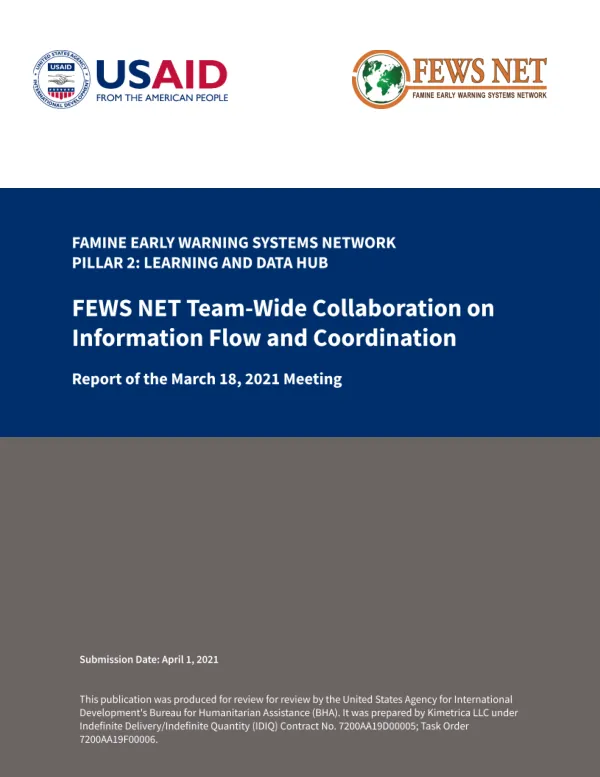
The Famine Early Warning Systems Network (FEWS NET) Pillar 2: Learning and Data Hub is a critical component of the FEWS NET project, which aims to provide early warnings of potential famines and food insecurity.
2021 · 36 pages
Sign in to readA free account is required to download.
Abstract
The Learning and Data Hub is responsible for collecting, analyzing, and disseminating data to support decision-making and program implementation. The FEWS NET Collaboration Meeting on Information Flow and Coordination was held on March 18, 2021, with 27 participants representing the US Agency for International Development (USAID), the FEWS NET Early Warning (EW) team, the Learning and Data Hub (Hub) team, and the Science team. The meeting provided an opportunity for the teams to share updates on their collaboration activities and discuss key issues related to data permissions and sharing. The Science team reported on several collaborative activities, including outlining the scope and selecting geographies for the Southern Africa Crop Tour, updating livelihood geographies for Zimbabwe, Sudan, and Uganda, and sharing SERVIR training documents and lessons learned. The Early Warning-Hub team collaborations included jointly identifying and programming interviews for external stakeholders, continuing analysis of the Zimbabwe Food Security Outlook, and preparing a section on the FEWS NET website to publish the EW team's quarterly public regional briefings. The Hub team also shared that USAID recently approved the FEWS NET Brand Identity activity, which will require input from all FEWS NET implementing partners. The work will begin in April and include a revised statement of purpose for the project, refreshed brand book, new reporting templates, and guidance on visualizations. USAID provided a plan for updating the Project's data permissions structures based on situating the FEWS NET project in the context of USAID's recently published Digital Strategy. The plan aims to balance the need to protect individual privacy with the need to share data to support decision-making and program implementation. USAID also shared several quotes from relevant Automated Directives System (ADS) policies, including the requirement to submit data to the Development Data Library (DDL) and the need to provide clear justification for closed data. The FEWS NET project must make all data available to other parts of USAID, with only certain exceptions as outlined in USAID policy. The project should assume that USAID will open the data unless there are solid, clearly mapped justifications not to do so. USAID noted that written justifications for principled exceptions should be tailored to the context and will require clear, consistent definitions and internally shared phrasing to ensure longevity and broad acceptance among both FEWS NET partners and USAID. Applying the Principle Exceptions to the specific case of FEWS NET, USAID identified three risks of sharing data faced by the project: staff security, intellectual property, and data quality. The project must carefully consider these risks and develop strategies to mitigate them in order to ensure the safe and effective sharing of data. The FEWS NET project must also consider incorporating embargo agreements into the system to ensure that sensitive data is not shared without proper authorization. The project should work closely with USAID to develop a comprehensive data sharing plan that balances the need to protect individual privacy with the need to share data to support decision-making and program implementation. In conclusion, the FEWS NET Pillar 2: Learning and Data Hub plays a critical role in supporting the FEWS NET project's goals and objectives. The project must carefully consider the risks and challenges associated with data sharing and develop strategies to mitigate them in order to ensure the safe and effective sharing of data.