USAID DEC
Gender and Inclusive Development Action Plan (GIDAP) for Harmonia – Communities Ending Gender-Based Violence
Sign inHEALTH ALLIANCE INTERNATIONAL
Gender and Inclusive Development Action Plan (GIDAP) for Harmonia – Communities Ending Gender-Based Violence
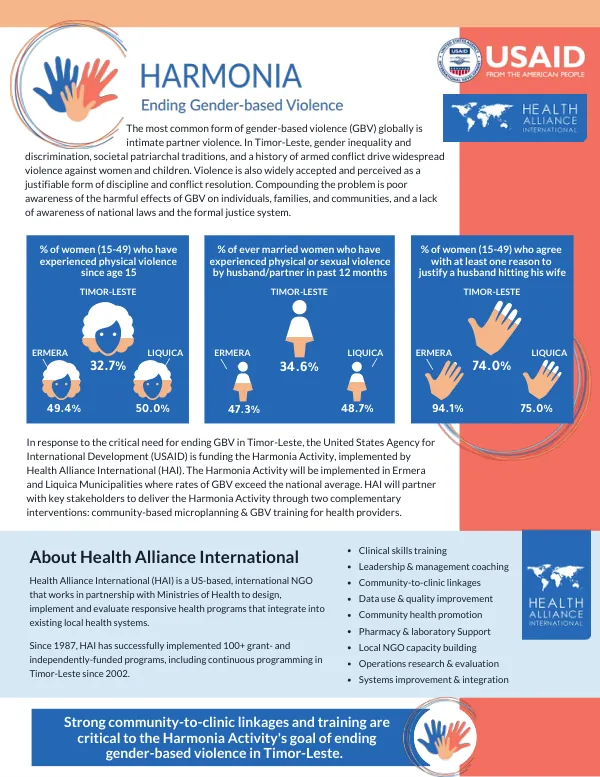
The Harmonia Activity in Timor-Leste aims to address the underlying contributors to gender-based violence (GBV) and improve the ability of community leaders and family members to support survivors of violence.
2021 · 18 pages
Sign in to readA free account is required to download.
Abstract
The activity will engage with communities and the health system in two municipalities, Ermera and Liquica, to plan and conduct community-led initiatives to end GBV. The Gender and Inclusive Development Action Plan (GIDAP) outlines the Harmonia Activity's planned structure, implementation, and evaluation to ensure considerations are identified and prioritized to maximize the activity's sustainability and successful implementation efforts. The GIDAP is informed by HAI's Gender Equality and Social Inclusion (GESI) analysis, which aims to improve understanding of the drivers of gender inequality and GBV. The GESI analysis identified several priority gender gaps, including cultural beliefs and social norms that disempower women, widely held attitudes among men and women that normalize and justify violence, limited community understanding of gender inequality as a root cause of violence against women, and lack of awareness of national laws and access to information by the public. To address these gaps, the Harmonia Activity proposes two key interventions: Community Microplanning (CMP) and Responding to GBV Learning Labs. Community Microplanning will bring together an inclusive, intergenerational coalition of community members to discuss harmful social norms related to GBV and identify solutions. The CMP group will consist of approximately 10 members, representing and leading their community in community engagement activities over a 12-month period. The group will hold monthly Community Information and Learning sessions to address the goals of the action plan. Responding to GBV Learning Labs will be implemented to increase awareness, knowledge, sensitivity, and counseling skills of health providers to screen for and support survivors of GBV. The Learning Lab will be preceded by an intensive training course that will train health providers on key concepts related to recognizing and responding to GBV in their clients. The Harmonia Activity will use a Plan-Do-Study-Act (PDSA) model to implement the CMP and Responding to GBV Learning Labs. The activity will also conduct baseline and endline surveys among CMP participants to measure the effectiveness of the interventions. The GIDAP outlines the indicators and methods of verification for the activity's outcomes, including the percentage of CMP participants who demonstrate improved knowledge about laws related to GBV and the percentage of CMP groups who have developed and implemented an action plan to address GBV in their communities. The Harmonia Activity aims to improve the ability of community leaders and family members to support survivors of violence and to improve health facility services and the referral system for survivors of GBV. The activity will engage with communities and the health system in two municipalities, Ermera and Liquica, to plan and conduct community-led initiatives to end GBV. The GIDAP outlines the Harmonia Activity's planned structure, implementation, and evaluation to ensure considerations are identified and prioritized to maximize the activity's sustainability and successful implementation efforts.
Related documents