USAID DEC
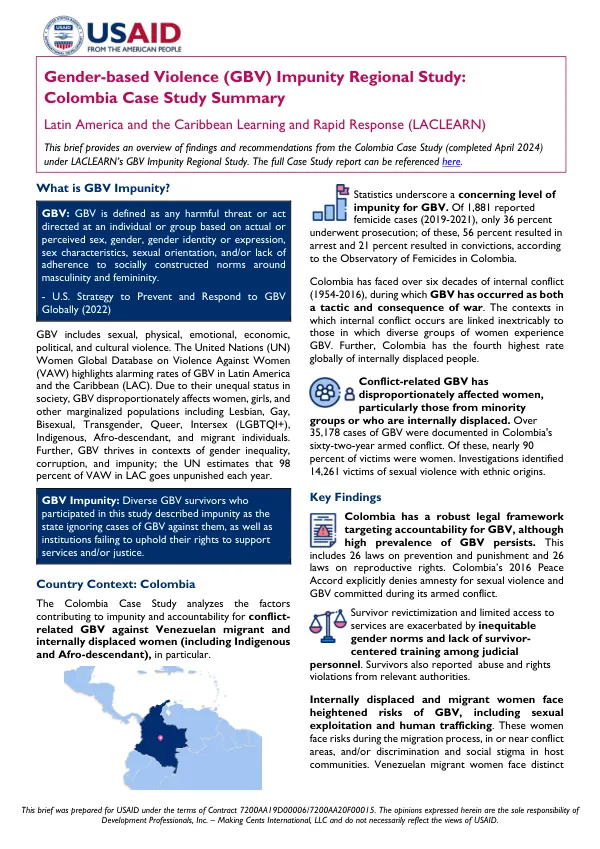
Gender-based Violence (GBV) Impunity Regional Study: Colombia Case Study Summary
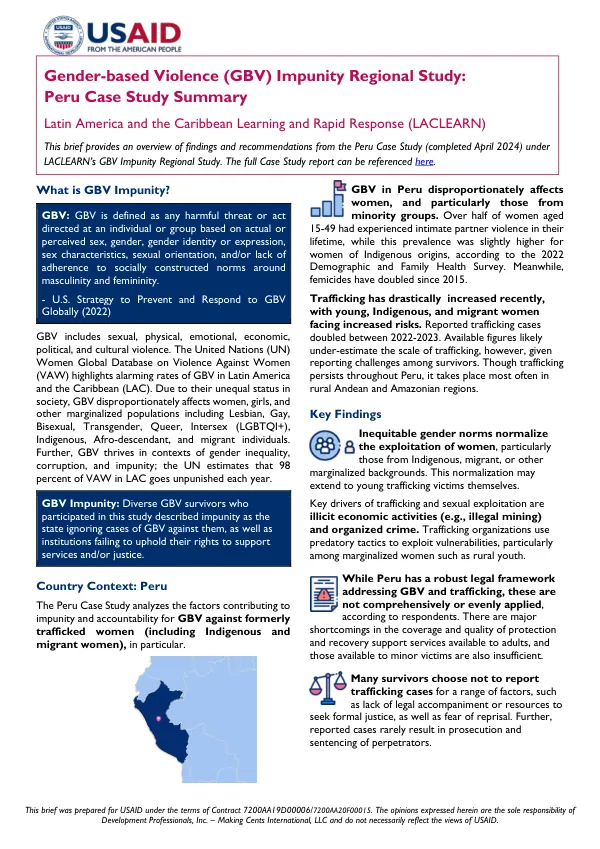
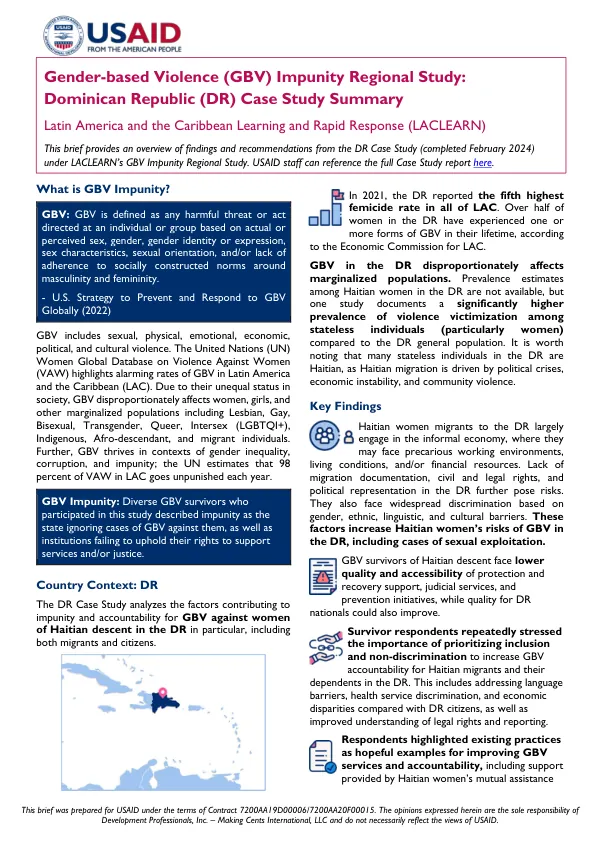
The Colombia Case Study, conducted under the LACLEARN GBV Impunity Regional Study, examines the factors contributing to impunity and accountability for conflict-related Gender-Based Violence (GBV) against Venezuelan migrant and internally displaced women, particularly those from minority groups.
2024 · 2 pages
Sign in to readA free account is required to download.
Abstract
GBV is defined as any harmful threat or act directed at an individual or group based on actual or perceived sex, gender, gender identity, or expression, sex characteristics, sexual orientation, and/or lack of adherence to socially constructed norms around masculinity and femininity. GBV includes sexual, physical, emotional, economic, political, and cultural violence, and disproportionately affects women, girls, and other marginalized populations, including Lesbian, Gay, Bisexual, Transgender, Queer, Intersex (LGBTQI+), Indigenous, Afro-descendant, and migrant individuals. In Colombia, a robust legal framework targeting accountability for GBV exists, but high prevalence of GBV persists. The country has 26 laws on prevention and punishment and 26 laws on reproductive rights, and the 2016 Peace Accord explicitly denies amnesty for sexual violence and GBV committed during the armed conflict. Survivor revictimization and limited access to services are exacerbated by inequitable gender norms and lack of survivor-centered training among judicial personnel. Survivors also reported abuse and rights violations from relevant authorities. Internally displaced and migrant women face heightened risks of GBV, including sexual exploitation and human trafficking, and encounter unique obstacles and structural racism in seeking protection and justice. Many have been historically dispossessed of land, territories, and natural resources, and/or have experienced multiple instances of internal displacement. The Colombia Case Study proposes three strategic pathways to improve GBV accountability: 1) protection and recovery support, 2) criminal justice services, and 3) prevention initiatives. Across pathways, inclusive activity design and implementation among the state, civil society, and diverse GBV survivors should ensure the unique needs of each community are met. Protection and recovery support should ensure culturally-appropriate and accessible shelters for diverse women survivors, increase service coverage in remote areas through mobile support units, and provide trauma-informed mental health support, accounting for post-conflict survivor needs. Criminal justice services should provide specialized legal aid, accounting for unique needs of migrant and internally displaced women, build capacities of judicial personnel in delivering trauma-informed services for GBV response, and facilitate harmonization of legal frameworks regarding internal displacement and GBV. GBV prevention initiatives should implement transformative social norm change programs to address discrimination and stigma, implement mobile and radio-based GBV early warning systems for diverse survivors, and build civil society organization (CSO) capacities, specifically those representing diverse women, in GBV prevention efforts. The LACLEARN GBV Impunity Regional Study, conducted from 2021 to 2024, utilized a political economy approach to investigate factors driving GBV impunity, barriers to GBV accountability, and survivor-centered solutions across Latin America and the Caribbean. The study is based on an extensive desk review and key informant interviews with over 230 diverse GBV survivors, local CSOs, and government service providers. Research methods prioritized the safety and respect of both subjects and researchers, who also come from affected communities.