USAID DEC
Generación Cero: How art and music join their voices against discrimination in the region
Sign inUSAID
Generación Cero: How art and music join their voices against discrimination in the region
The Generación Cero social movement in Central America emerged as a result of a regional study conducted by the Pan American Social Marketing Organization (PASMO) under the USAID Combination Prevention Program for HIV in Central America.
2013 · 1 pages
Sign in to readA free account is required to download.
Abstract
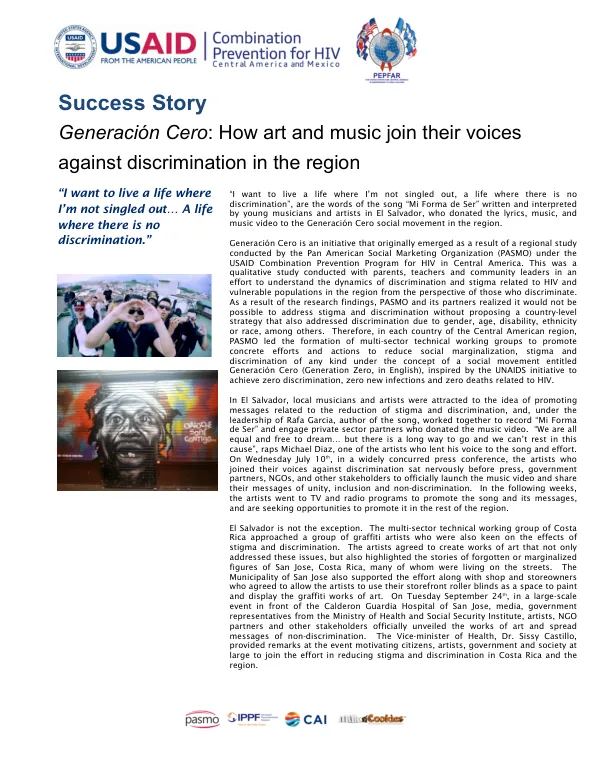
This qualitative study aimed to understand the dynamics of discrimination and stigma related to HIV and vulnerable populations in the region from the perspective of those who discriminate. The research findings revealed that addressing stigma and discrimination would require a country-level strategy that also addressed discrimination due to gender, age, disability, ethnicity, or race, among others. As a result, PASMO led the formation of multi-sector technical working groups in each country of the Central American region to promote concrete efforts and actions to reduce social marginalization, stigma, and discrimination. The initiative, entitled Generación Cero, was inspired by the UNAIDS initiative to achieve zero discrimination, zero new infections, and zero deaths related to HIV. The movement aimed to promote messages related to the reduction of stigma and discrimination, and local musicians and artists were attracted to the idea of engaging in this effort. In El Salvador, local musicians and artists, led by Rafa Garcia, author of the song "Mi Forma de Ser," worked together to record the song and engage private sector partners who donated the music video. The song's message emphasizes the importance of unity, inclusion, and non-discrimination. The artists, including Michael Diaz, who lent his voice to the song, expressed their commitment to promoting the message of equality and freedom. The music video was officially launched in a press conference, and the artists went on to promote the song and its messages through TV and radio programs. The Generación Cero initiative is not limited to El Salvador. In Costa Rica, a multi-sector technical working group approached a group of graffiti artists who were keen on addressing the effects of stigma and discrimination. The artists created works of art that highlighted the stories of forgotten or marginalized figures of San Jose, Costa Rica. The Municipality of San Jose and shop and storeowners supported the effort, allowing the artists to use their storefront roller blinds as a space to paint and display the graffiti works of art. The event was officially unveiled in front of the Calderon Guardia Hospital of San Jose, with remarks from the Vice-minister of Health, Dr. Sissy Castillo, motivating citizens, artists, government, and society at large to join the effort in reducing stigma and discrimination in Costa Rica and the region. The Generación Cero social movement has brought together artists, musicians, and stakeholders to promote messages of unity, inclusion, and non-discrimination in Central America. Through music, art, and community engagement, the initiative aims to reduce social marginalization, stigma, and discrimination, and promote a culture of equality and respect for all individuals.