CARE
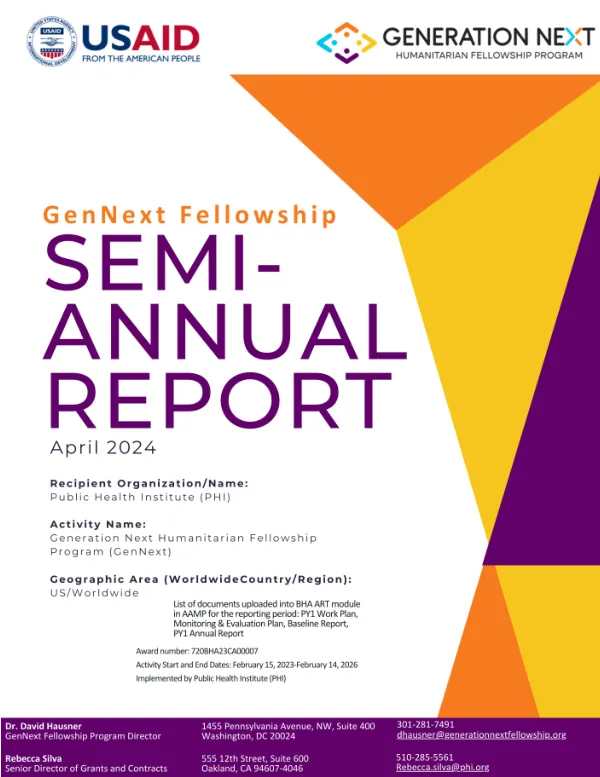
Generation Next Fellowship Annual Report
The Generation Next Humanitarian Fellowship Program (GenNext) is a USAID Minority Serving Institutions (MSI) Fellowship Program designed to increase capacity and support inclusivity for humanitarian careers among diverse Fellows.
2023 · 22 pages
Sign in to readA free account is required to download.
Abstract
The program aims to foster linkages between academic MSIs and US-based humanitarian organizations. The program's first year, known as Program Year (PY1), began on February 15, 2023, and concluded on September 30, 2023. During PY1, the program team and consortium partners, including the Public Health Institute (PHI) and CARE, Global Communities, Project Hope, and Save the Children, designed and co-created systems and processes for the fellowship lifecycle and various components of the program. These systems and processes will serve as the foundation for driving the program toward its two main objectives. The co-creation process involved various methods, including written communications, virtual meetings, virtual brainstorming, and polling, as well as an in-person, two-day meeting. This process fostered participation from all consortium partners in designing the program and provided a platform for a truly collaborative fellowship program. The co-creation process was used to develop the program systems, the fellowship curriculum, a new program name and branding, and to begin the process of setting up the host site positions and outreach for recruitment of the Fellows. In an effort to expand the program's reach and impact, a Request for Application (RFA) was launched on June 23, 2023, to attract new humanitarian assistance organization collaborators who share the program's mission. However, the low response to the RFA posed a significant challenge due to the cost share requirement, which many organizations are federally funded. The program management team is actively addressing this hurdle by leveraging USAID's recent reduction in the cost share requirement, which is expected to incentivize a broader spectrum of organizations to engage with the program. The program team also reached out to potential host organization partners that had initially expressed interest in joining the consortium to understand why they had not applied to the RFA. The responses were consistently related to time and money constraints, including the lack of time to complete the proposal and the non-federal budget available to cover the cost share required to participate. To address these challenges, the program team is planning to remove the RFA and corresponding proposal requirement and simply accept expressions of interest along with the necessary documentation to develop sub-partner agreements. This change is expected to attract more potential host partners to the program, resulting in more postings for the second cohort of Fellows. The program's focus on fostering linkages with Minority Serving Institutions (MSIs) is critical to achieving its objectives. MSIs play a vital role in providing education and training to diverse students, and the program aims to leverage these institutions to increase capacity and support inclusivity for humanitarian careers among diverse Fellows. By fostering linkages between MSIs and US-based humanitarian organizations, the program seeks to create a pipeline of diverse professionals who can contribute to the humanitarian sector. Overall, the Generation Next Humanitarian Fellowship Program is making significant progress in its first year, with a focus on co-creation, partnerships, and linkages with MSIs. The program's efforts to address the challenges posed by the cost share requirement and to remove the RFA and proposal requirement are expected to attract more potential host partners and result in more postings for the second cohort of Fellows.