CARE
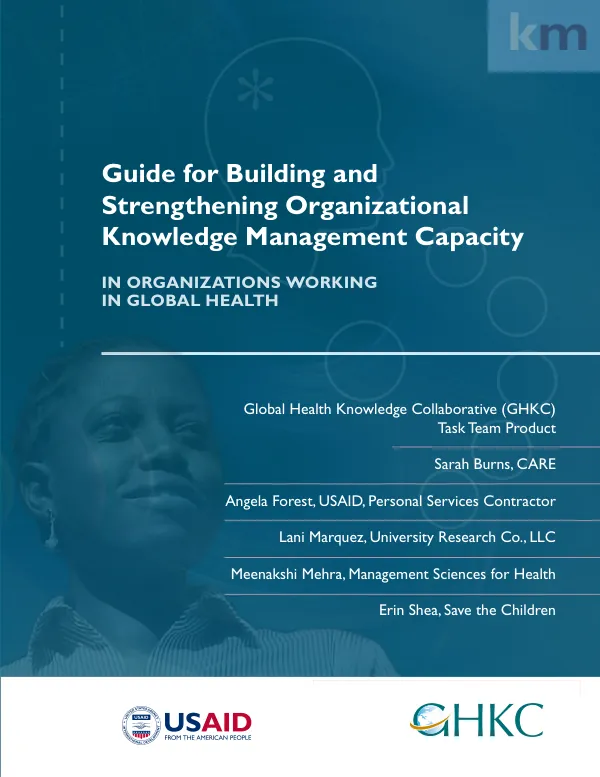
Guide for Building and Strengthening Organizational Knowledge Management Capacity
The Global Health Knowledge Collaborative (GHKC) Task Team Product is a comprehensive guide for building and strengthening organizational knowledge management capacity in organizations working in global health.
2021 · 72 pages
Sign in to readA free account is required to download.
Abstract
The guide is a collaborative effort between several organizations, including CARE, USAID, University Research Co., LLC, Management Sciences for Health, and Save the Children. The guide emphasizes the importance of knowledge management (KM) in organizations working in global health, highlighting its value in improving organizational performance, enhancing decision-making, and promoting innovation. The guide defines KM as the systematic process of creating, capturing, storing, retrieving, and sharing knowledge to achieve organizational goals. The guide identifies several key objectives that organizations pursue with KM, including solving cross-functional issues, documentation and communication, staff experience capture, pause and reflect, peer-to-peer learning, and curating, organizing, storing, and using structured knowledge. The guide also discusses the importance of leveraging project KM to support organizational KM and provides examples of common KM activities used to pursue these objectives. The guide outlines the organizational structures, roles, and functions necessary for effective KM, including executive office/strategy, cross-functional working group, communications, human resources, monitoring, evaluation, and learning, technical programs, and information technology. The guide also provides guidance on how to formulate roles and job descriptions for KM positions, including characteristics and behaviors, paid interns, junior roles, advisors/managers, and directors/leadership roles. The guide discusses the tools and approaches used in KM, including tools for solving cross-functional issues, documentation and communications, staff experience capture, pause and reflect, peer-to-peer learning, and curating, organizing, storing, and using structured knowledge. The guide also provides guidance on how to prioritize tools and approaches and how to evaluate the effectiveness of KM initiatives. The guide emphasizes the importance of building KM capacity in an organization, including developing a KM strategy, establishing a KM infrastructure, and providing training and support for KM staff. The guide also discusses the evaluation of KM initiatives, including metrics for measuring KM effectiveness and best practices for evaluating KM programs. Overall, the GHKC Task Team Product provides a comprehensive guide for organizations working in global health to build and strengthen their KM capacity. The guide offers practical advice and examples for implementing KM initiatives and provides a framework for evaluating the effectiveness of KM programs.
Related documents