USAID DEC
GESTION DES PEPINIERES ET TECHNIQUES DE PROPAGATION DES ARBRES FRUITIERS ET FORESTIERS
Sign inUSAID DEC
GESTION DES PEPINIERES ET TECHNIQUES DE PROPAGATION DES ARBRES FRUITIERS ET FORESTIERS
The REGIS-ER project, "Résilience et Croissance Economique au Sahel – Résilience Renforcée," aimed to promote agricultural development in the Sahel region.
2016 · 31 pages
Sign in to readA free account is required to download.
Abstract
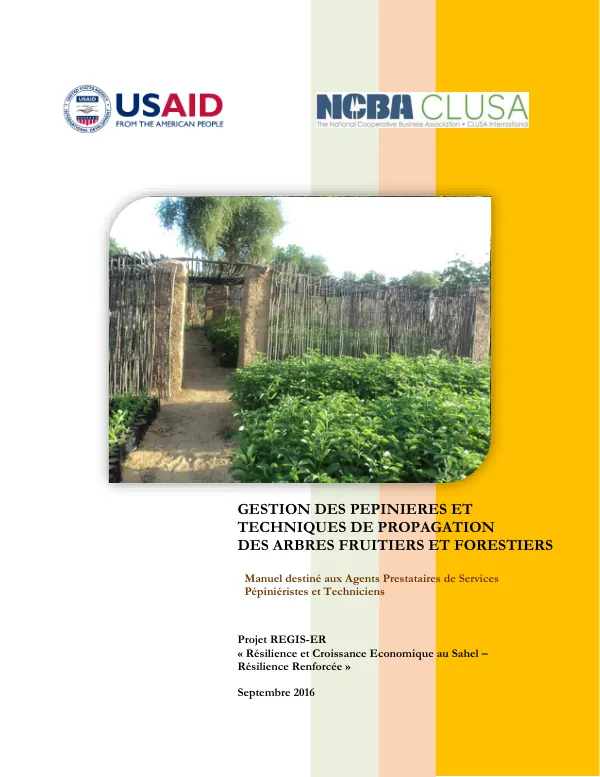
The project focused on improving the production of horticultural and forest crops through the establishment of nurseries and the development of techniques for propagating fruit and forest trees. The manual for the REGIS-ER project provided guidance for agents, nursery operators, and technicians on the management of nurseries and techniques for propagating fruit and forest trees. The manual covered topics such as the establishment of a nursery, the construction of a greenhouse, and the development of a medium for plant culture. The establishment of a nursery required careful planning and consideration of several factors, including the choice of site, the delimitation of the nursery, and the compartmentalization of the nursery. The site chosen for the nursery should have access to water and be easily accessible in all seasons. The nursery should be divided into areas for production, shade, and separation of plantings. The construction of a greenhouse was also an important aspect of the nursery establishment. The greenhouse should be designed to provide adequate shade and protection from the elements. The manual recommended the use of 9 pillars made of brick or cement, with a height of 2 meters and a spacing of 3 meters between each pillar. The medium for plant culture was also an important consideration in the establishment of a nursery. The manual recommended the use of a mixture of local soil, compost, and sand in the ratio of 2:1:1. The compost was an essential component of the medium, as it provided nutrients and improved the structure of the soil. The composting process was an important aspect of the nursery establishment. The manual provided guidance on the construction of a composting pit and the process of composting. The composting pit should be located near a source of water and should be designed to allow for easy access and aeration. The composting process involved the addition of different types of organic matter, such as leaves, grass, and animal manure, to the composting pit. The pit should be covered with a layer of soil or a tarp to retain heat and moisture. The compost should be turned regularly to ensure aeration and to prevent the buildup of anaerobic conditions. The REGIS-ER project aimed to improve the production of horticultural and forest crops in the Sahel region through the establishment of nurseries and the development of techniques for propagating fruit and forest trees. The project provided guidance for agents, nursery operators, and technicians on the management of nurseries and techniques for propagating fruit and forest trees.
Related documents