SOCIAL IMPACT, INC.
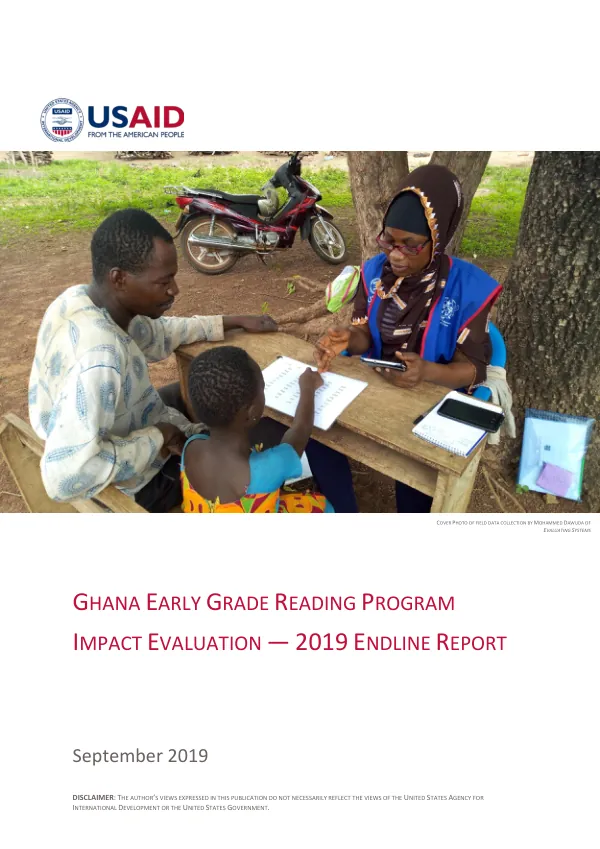
Ghana Early Grade Reading Program Impact Evaluation - 2019 Endline Report
The Ghana Early Grade Reading Program Impact Evaluation — 2019 Endline Report was conducted to assess the effectiveness of the Early Grade Reading Program in improving reading skills among Ghanaian pupils.
2019 · 135 pages
Sign in to readA free account is required to download.
Abstract
The program aimed to enhance reading skills in both Ghanaian Language of Instruction (LOI) and English, as well as increase teacher and pupil time on task in primary one and two classrooms. The evaluation used a randomized controlled trial design, with 400 schools randomly assigned to either the treatment or control group. Data collection methods included surveys, interviews, and observations, which were conducted at the beginning and end of the two-year implementation period. The data analysis focused on comparing the outcomes of pupils in the treatment and control groups. The results showed that the Early Grade Reading Program had a significant positive impact on reading skills among Ghanaian pupils. Pupils in the treatment group demonstrated a 27% increase in reading skills in Ghanaian LOI and a 25% increase in reading skills in English compared to the control group. The program also improved teacher and pupil time on task in primary one and two classrooms, with teachers in the treatment group spending more time on reading instruction and pupils engaging more frequently with books. The evaluation also found that the program had a positive impact on teacher practices, with teachers in the treatment group more likely to apply program-aligned best practices in teaching early grade reading. The program also increased the likelihood that teachers engaged in adaptive teaching and adapted instructional approaches in response to coach and mentor feedback. However, the evaluation also identified some contextual factors that affected the success of the program. For example, pupils in schools with higher asset levels and those who were matched with their language of instruction showed greater gains in reading skills. The evaluation also found that the program had a positive impact on equity, with pupils from disadvantaged backgrounds showing greater gains in reading skills. The evaluation concluded that the Early Grade Reading Program was effective in improving reading skills among Ghanaian pupils and had a positive impact on teacher practices. The program's success was attributed to its focus on teacher training, instructional materials, and coaching and mentoring. The evaluation recommended that the program be scaled up to reach more pupils and that further research be conducted to identify the most effective components of the program. The results of the evaluation were presented in a framework that showed the program's effects on reading skills, teacher practices, and pupil engagement. The framework also highlighted the program's impact on equity and accountability. The evaluation's findings and recommendations were intended to inform policymakers and educators in Ghana and other countries about the effectiveness of the Early Grade Reading Program and its potential to improve reading skills among pupils.
Related documents