AVENIR HEALTH
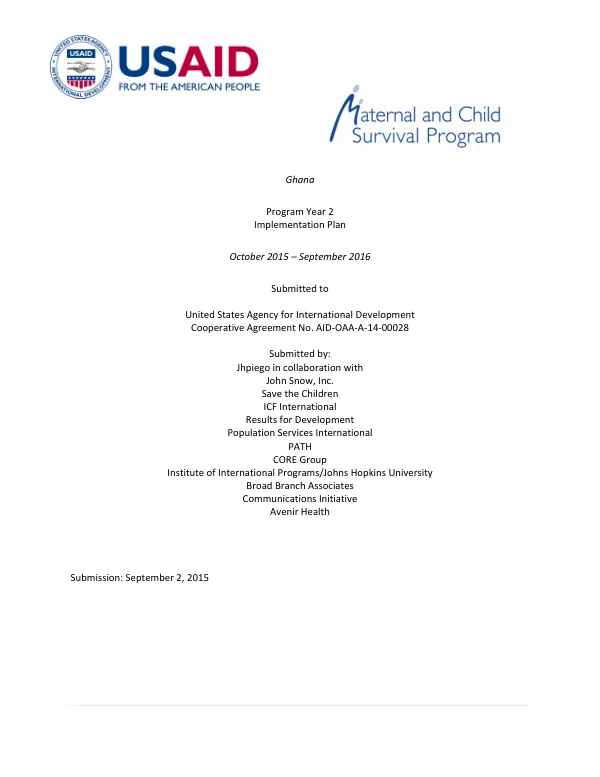
Ghana Program Year 2 Implementation Plan
The Maternal and Child Survival Program in Ghana is a global U.S.
2015 · 68 pages
Sign in to readA free account is required to download.
Abstract
Agency for International Development (USAID) cooperative agreement aimed at introducing and supporting high-impact health interventions to end preventable child and maternal deaths within a generation. The program engages governments, policymakers, private sector leaders, health care providers, civil society, faith-based organizations, and communities in adopting and accelerating proven approaches to address the major causes of maternal, newborn, and child mortality and improve the quality of health services from household to hospital. The program focuses on health systems strengthening, household and community mobilization, equity, gender, eHealth, and other cross-cutting approaches. Ghana made significant progress between 2008 and 2014 in decreasing maternal, infant, and under-five child mortality. However, the latest Demographic Health Surveys (DHS) in 2014 show that there has been a slight increase in total fertility rate, and 30 percent of married women and 42 percent of unmarried sexually active women still have an unmet need for family planning. The program has identified several key objectives, including a better prepared midwifery and nursing workforce equipped with the knowledge and skills to effectively provide HIV, malaria, nutrition, family planning, and maternal, newborn, and child health services. The program also aims to standardize and approve the national Community-based Health Planning Service (CHPS) strategy, guidelines, training materials, tools, and monitoring systems. Additionally, the program seeks to strengthen management and support systems in USAID/MCSP-supported regions and districts to implement CHPS according to updated and harmonized policy and guidelines and provide high-quality HIV, malaria, family planning, nutrition, and maternal, newborn, and child health services. The program budget for Workplan Year 2 (October 2015-September 2016) is $4,057,172, with a breakdown of $1,488,714 for Maternal and Child Health (MCH), $87,998 for Water, Sanitation, and Hygiene (WAS), $1,008,772 for Family Planning (FP), $910,316 for Malaria, $264,185 for HIV, and $297,187 for Nutrition. The program will engage with various in-country partners, including the Human Resource for Health Development Unit (HRHD) of the Ministry of Health (MOH) of Ghana, the National Programs of the Ghana Health Services (GHS), and other bilateral and global programs. The program will implement several activities, including training of midwives and nurses, development of CHPS strategy and guidelines, strengthening of management and support systems, and provision of high-quality health services. The program will also monitor and evaluate its progress through a Performance Monitoring Plan (PMP) and a Monitoring, Measurement, Evaluation, and Action-Oriented Learning (MMEL) activity plan.