USAID DEC
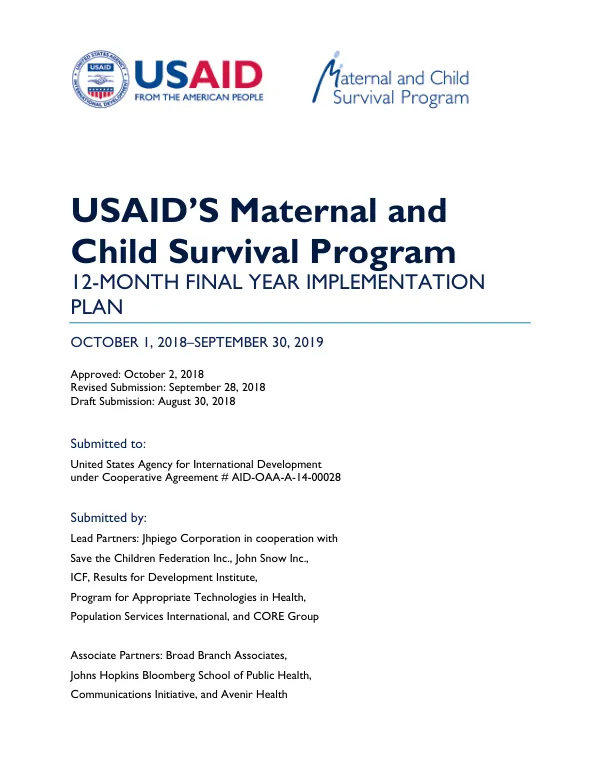
USAID’s Maternal and Child Survival Program, 12-MONTH FINAL YEAR IMPLEMENTATION PLAN
Sign inAVENIR HEALTH
USAID’s Maternal and Child Survival Program, 12-MONTH FINAL YEAR IMPLEMENTATION PLAN
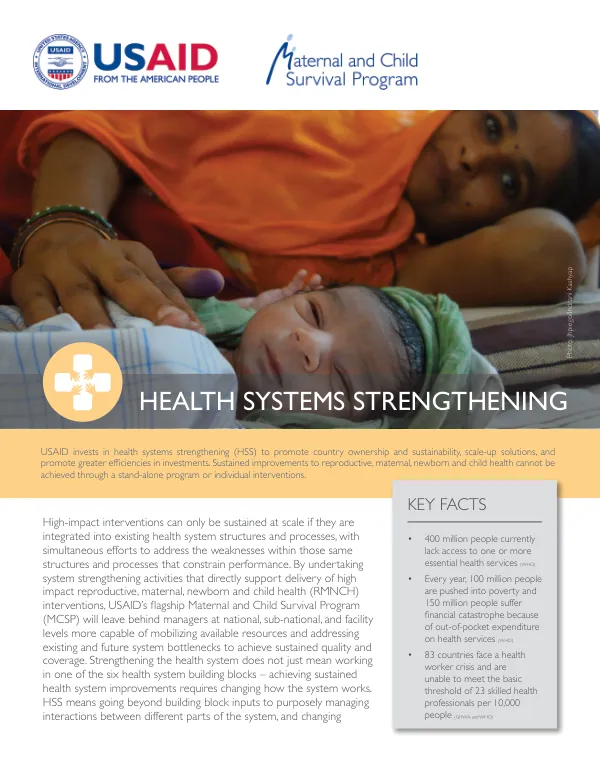
The Maternal and Child Survival Program (MCSP) is a global USAID Cooperative Agreement that aims to introduce and support high-impact health interventions in 25 priority countries.
2018 · 17 pages
Sign in to readA free account is required to download.
Abstract
The ultimate goal of MCSP is to prevent child and maternal deaths. MCSP supports programming in maternal, newborn, and child health; immunization; family planning and reproductive health; nutrition; health systems strengthening; water/sanitation/hygiene; malaria; prevention of mother-to-child transmission of HIV; and pediatric HIV care and treatment. MCSP will tackle these issues through approaches that also focus on health systems strengthening, household and community mobilization, gender integration, and digital health, among others. MCSP has a presence in 18 countries implementing 26 programs, with a focus on increasing effective coverage and quality of reproductive, maternal, newborn, child, and adolescent health (RMNCAH) services. Since inception, MCSP has worked in 40 countries in varying capacities. The program has been responsive to emerging threats and issues challenging the health system in several countries, including Zika in the Latin America and Caribbean region, Ebola in Guinea, Liberia, and Ghana, and plague and cholera outbreaks in Madagascar and Democratic Republic of the Congo (DRC). MCSP's program learning agenda has been categorized into seven implementation and learning themes: achieving sustainable impact at scale; quality; equity, including gender equity; health systems strengthening (HSS); community action for health; innovations to address key gaps in coverage, quality, or equity; and measurement and data use for action and accountability. MCSP's project-wide dissemination strategy celebrates each of the seven implementation and learning themes, convening key partners to engage in a dialogue around the latest evidence and learning from the project. The PY5 core work plan represents a culmination of continued investments in global technical leadership, strategic country investments, and the realization and sharing of an ambitious program learning agenda. At the end of five years, MCSP aims to have moved further along its vision of having improved country self-reliance and health system performance to ensure better quality of care at scale. MCSP received a no-cost extension that changes the end date of the program from March 16, 2019, to December 31, 2019. MCSP's implementation plan for the 2018-2019 program year focuses on achieving sustainable impact at scale, improving quality of care, and strengthening health systems. The program will continue to support country-level implementation of high-impact health interventions, with a focus on maternal, newborn, and child health; immunization; family planning and reproductive health; and nutrition. MCSP will also continue to support health systems strengthening, including health information systems, health workforce development, and health financing. In addition, MCSP will continue to support community action for health, including social and behavior change communication, community health worker training, and community-based health services. The program will also continue to support innovations to address key gaps in coverage, quality, or equity, including the use of digital health technologies and the development of new health products and services. MCSP's measurement and data use for action and accountability will continue to be a key focus area, with a focus on improving data quality, increasing data use, and supporting country-level monitoring and evaluation. MCSP's geographic focus is on 25 priority countries, with a focus on increasing effective coverage and quality of reproductive, maternal, newborn, child, and adolescent health (RMNCAH) services. The program has a presence in 18 countries implementing 26 programs, with a focus on maternal, newborn, and child health; immunization; family planning and reproductive health; nutrition; health systems strengthening; water/sanitation/hygiene; malaria; prevention of mother-to-child transmission of HIV; and pediatric HIV care and treatment. MCSP's timeframes for the 2018-2019 program year are from October 1, 2018, to September 30, 2019, with a final administrative wrap-up and closeout period from October 1, 2019, to December 31, 2019. The plans and funding for the October-December 2019 period will be discussed with USAID midway through the PY5 period.
Related documents