AVENIR HEALTH
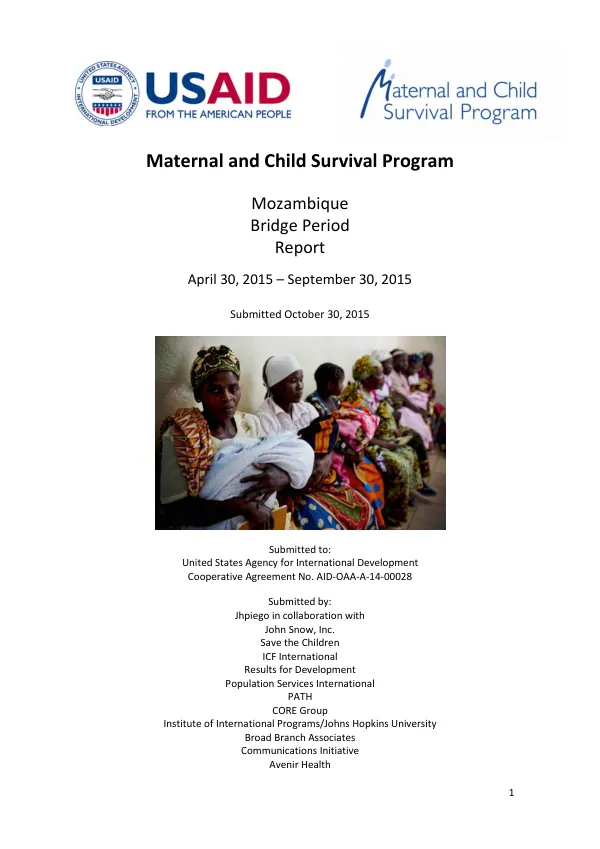
Maternal and Child Survival Program Bridge Period Report
The Maternal and Child Survival Program in Mozambique began on April 30, 2015, and concluded on September 30, 2015.
2015 · 30 pages
Sign in to readA free account is required to download.
Abstract
The five-month bridge period aimed to continue and complete critical activities of the MCHIP Associate Award, particularly in support of the Ministry of Health's national priorities: the Model Maternity Initiative (MMI) and the National Cervical Cancer Prevention and Control Program (CECAP). The Bridge program also facilitated transition and preparation for the multi-year MCSP program to begin on October 1, 2015. The goal of the MCSP Bridge program was to reduce maternal, newborn, and child mortality in Mozambique through the scale-up of high-impact interventions and increased use of MNCH, FP/RH, and HIV services. To achieve this goal, MCSP provided support to the Ministry of Health to accomplish four objectives. Objective 1 aimed to increase coverage of high-impact RMNCH interventions and respectful care at both the community and health facility levels. Objective 2 focused on strengthening health systems to deliver quality RMNCH services, with an emphasis on data and human resources management, and linkages between community and facility services. Objective 3 aimed to improve the environment for the delivery of high-impact RMNCH interventions and respectful care through technical leadership and coordination. Objective 4 targeted strengthening child health in facilities implementing the MMI through in-service training and Integrated Management of Childhood Illnesses (IMCI) management. During the Bridge period, MCSP provided support at the national, provincial, health facility, and community levels. All 11 provinces received technical assistance for MMI, CECAP, and newborn and child health implementation, while MCSP strengthened community interventions in target districts within 7 provinces. Scaled-up quality, high-impact, and respectful MNH interventions were implemented in 125 maternities. The MMI was expanded from 34 health facilities at the beginning of 2011 to 125 health facilities by September 2015. By September, 38% (48/125) of all facilities involved in the MMI had achieved 80% or more of all standards on their last measurement. The practice of high-impact interventions was expanded, supported, and reinforced. These included completed partographs, treatment of severe pre-eclampsia and eclampsia with magnesium sulfate (MgSO4), and AMTSL. As the graph illustrates, the institutional maternal mortality ratio at MMI facilities declined over the course of five years as implementation of the three key high-impact interventions increased. Respectful MNH care practices were also expanded, with over 88% of newborns breastfed within the first hour of delivery and provided immediate skin-to-skin contact with the mother in September 2015, and over 65% of women who were accompanied by a companion for labor and delivery. MCSP supported the training of 111 health professionals in the visual inspection with acetic acid (VIA) screening approach and cryotherapy treatment during the Bridge period, increasing access for women to these vital services. VIA screening rate increased from 14% in 2011 to 48% in September 2015. By the end of September 2015, 95% of eligible women received cryotherapy on the same day or the days following screening. Mobilization of community groups to lead or engage in efforts to improve the health of their communities was also a key focus. During the Bridge period, MCSP provided financial support and community mobilization for the conduct of 96 mobile brigades, which included vaccination for 3,380 children, and the participation of 6,070 community members in educational sessions regarding family planning, the importance of pre and post-partum consultations, the new Rotavirus vaccine, exclusive breastfeeding, nutrition, institutional births, and diarrhea. MCSP also provided refresher training to 297 co-management committee members in themes including CMC tasks and objectives, elaboration of plans, and reporting results. The program's major accomplishments included increasing national coverage and quality of high-impact interventions for MNH at Model Maternity facilities and surrounding communities. Five additional health facilities received and passed a MOH-led external evaluation to confirm their status as a national Model Maternity facility in recognition of their sustained performance of 80% or more in all areas of the MMI Performance Standards. As of September 2015, 48 (38%) of 125 health facilities had achieved 80% or more of all MMI standards on their last SBM-R measurement. MCSP provided financial support for MOH national trainers to facilitate a provincial MMI training in Sofala and a regional MMI training (Central Region), for a total of 48 health professionals trained in high-impact, evidence-based maternal and newborn health practices, including respectful maternity care.
Related documents