USAID DEC
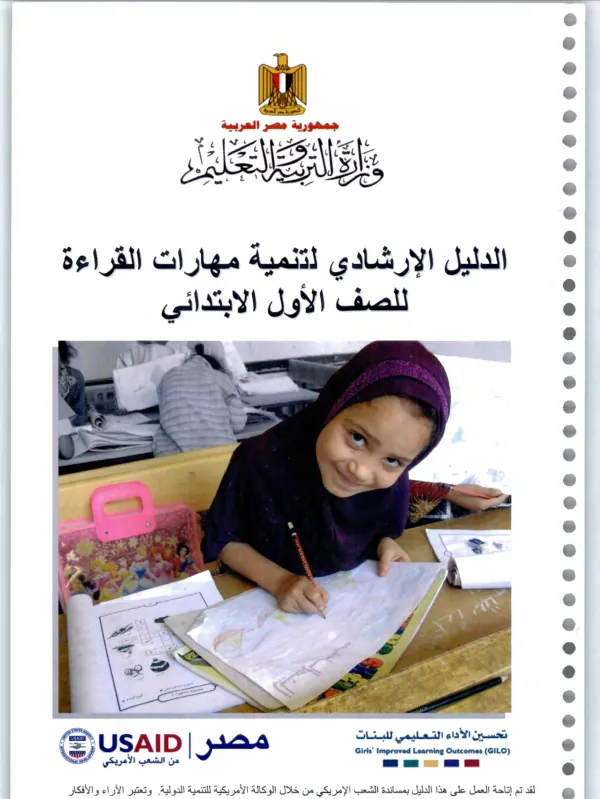
Girls' Improved Learning Outcomes (GILO) Project: Early Grade Reading Manual for First Grade
Sign inRTI INTERNATIONAL
Girls' Improved Learning Outcomes (GILO) Project: Early Grade Reading Manual for First Grade
The Girls' Improved Learning Outcomes (GILO) project is a development initiative implemented in Egypt from 2008 to 2011 by the United States Agency for International Development (USAID) in cooperation with the Ministry of Education.
2011 · 250 pages
Sign in to readA free account is required to download.
Abstract
The project aims to improve the quality of education and learning achievements among girls in grades K-9 in 2800 classrooms of 166 schools in four governorates: al-Fayoum, Beni Suef, al-Minia, and Qena. The project focuses on expanding coverage of girls' education, improving the quality of teaching and learning, and strengthening the management and governance of education at the school level in targeted communities. The lead implementer for the project is RTI International, with partner support from World Education, Keys to Effective Learning (KEYS), Community & Institutional Development (CID), and Infonex. An Early Grade Reading Assessment (EGRA) conducted in 2009 revealed that two-thirds of students in grades 2-4 were unable to read even a single word from a simple paragraph. Only 5% of grade 3 students met the fluency benchmark of about 50 words read per minute, which is standard for grade 1 students at the 50th percentile. In response to these findings, the Ministry of Education and GILO implemented a series of activities to improve reading performance among schoolchildren in the four governorates. A Working Group was established to design a plan to improve early grade reading in Arabic, which included reviewing documents to identify gaps and discussing best practices in teaching reading in the early grades. The Working Group introduced the Early Grade Reading Approach, focusing on Phonics, which has been introduced in over 35 countries internationally. This approach emphasizes the importance of phonics instruction in teaching reading skills. The project also developed Early Grade Reading Manuals used to conduct in-service training in selected schools in the four governorates and their supervisors. During these teacher trainings, 9000 teachers, head teachers, and supervisors received training in the five foundational reading skills with an emphasis placed on how to conduct phonics instruction. The project aimed to improve the reading skills of students in grades 2-4 and to increase the number of students who meet the fluency benchmark. The project's outcomes were evaluated through a second Early Grade Reading Assessment conducted in 2011. The assessment aimed to inform policy makers, curriculum developers, developmental partners, and practitioners on the impact of the interventions implemented since 2008. The assessment results showed improvements in reading skills among students in the four governorates, indicating the effectiveness of the project's interventions. The GILO project's success can be attributed to the collaborative efforts of the Ministry of Education, USAID, and the project's partners. The project's focus on improving reading skills among girls in grades K-9 has contributed to the improvement of education outcomes in Egypt. The project's approach to improving reading skills through phonics instruction has been successful in increasing the number of students who meet the fluency benchmark. The project's outcomes have implications for education policy and practice in Egypt. The findings of the Early Grade Reading Assessment highlight the need for continued investment in improving reading skills among students in grades 2-4. The project's approach to improving reading skills through phonics instruction can be replicated in other contexts to improve education outcomes. The GILO project's success has also contributed to the achievement of the Education For All (EFA) mission to provide universal access to primary education by 2015. The project's focus on improving reading skills among girls in grades K-9 has helped to increase access to education for girls in Egypt. The project's outcomes have also contributed to the improvement of education outcomes in Egypt, which is essential for achieving the EFA mission. The GILO project's approach to improving reading skills through phonics instruction has been successful in increasing the number of students who meet the fluency benchmark. The project's outcomes have implications for education policy and practice in Egypt, highlighting the need for continued investment in improving reading skills among students in grades 2-4.
Related documents