MINISTRY OF EDUCATION
Early Grade Reading Progress in Egypt
Early Grade Reading Progress in Egypt is a critical area of focus for the USAID Mission.
2014 · 7 pages
Sign in to readA free account is required to download.
Abstract
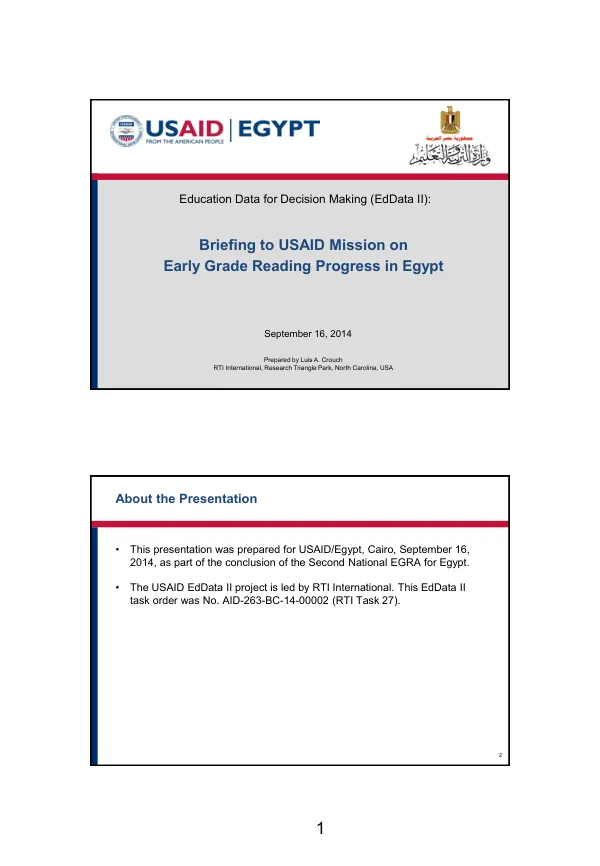
The country's education sector goal is to improve reading for 100 million children, with a particular emphasis on early grade reading. This goal is considered the most important in the education sector, and the USAID Mission is the largest donor in the world in this respect. The USAID EdData II project, led by RTI International, has been instrumental in piloting and scaling up early grade reading programs in Egypt. The project's efforts have yielded significant results, including doubling fluency scores and halving the number of non-readers in approximately two years, from 2009 to 2011. The Ministry of Education (MoE) has scaled up the program nationally, with minimal changes to the approach, and has continued to train teachers and print materials. The benchmarks for early grade reading in Egypt were set using a combination of statistical and scientific methods, as well as common sense and experience. The statistical approach involved analyzing baseline data, pilot experiences, and international standards to determine the comprehension level of 80% as the final aim. This was achieved by correlating fluency and accuracy with comprehension, and identifying the earlier skills needed for better fluency. The results of the early grade reading program in Egypt have been encouraging, with some key indicative results showing that 20% of children are at the 2018 benchmarks for letter sound knowledge, 4% for nonword decoding, 12% for oral reading fluency, and 5% for reading comprehension. Process indicators from classroom observation studies have also shown that 92% of teachers have received some training on teaching Grade 3 reading, and 75% of those who have received mastery monitoring training are applying it. However, there are still several issues and areas for improvement. The "wake-up" call from a midline assessment is often needed to prompt improvements, and in 2014, teachers had only four useful weeks to apply training due to political turmoil. Additionally, teachers may be "stuck" with Grade 1 and 2 skills and need training and specific tips on how to improve fluency and comprehension. The curriculum, assessment, and reading materials for Grade 3 were not as well-aligned as those for Grades 1 and 2, and more support is needed to improve this. Furthermore, the quality of teacher coaching models should be intensified, and the average quality of improvement varies significantly across different regions, with Upper Egypt requiring more support. To address these issues, several recommendations have been made, including remediating children who are particularly behind, popularizing and implementing more goal-orientation using the benchmarks, and creating incentives for reading improvement. Additionally, better overall planning and coordination are needed to ensure the success of the early grade reading program in Egypt.
Related documents