USAID DEC
Global Call to Action: maximize the public health impact of intermittent preventive treatment of malaria in pregnancy in sub-Saharan Africa
Sign inWORLD HEALTH ORGANIZATION
Global Call to Action: maximize the public health impact of intermittent preventive treatment of malaria in pregnancy in sub-Saharan Africa
Intermittent preventive treatment of malaria in pregnancy is a highly cost-effective intervention that significantly improves maternal and birth outcomes among mothers and their newborns who live in areas of moderate to high malaria transmission.
2015 · 6 pages
Sign in to readA free account is required to download.
Abstract
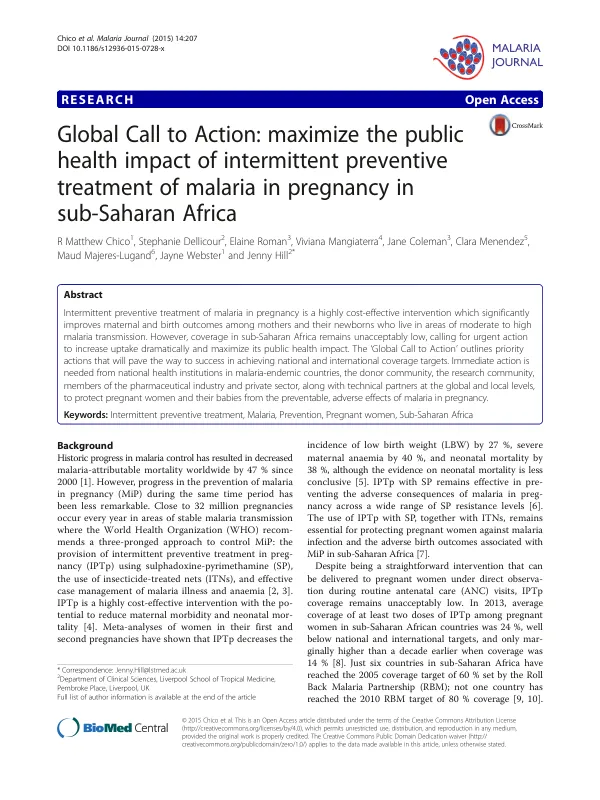
However, coverage in sub-Saharan Africa remains unacceptably low, calling for urgent action to increase uptake dramatically and maximize its public health impact. Historic progress in malaria control has resulted in decreased malaria-attributable mortality worldwide by 47% since 2000. However, progress in the prevention of malaria in pregnancy during the same time period has been less remarkable. Close to 32 million pregnancies occur every year in areas of stable malaria transmission where the World Health Organization recommends a three-pronged approach to control malaria in pregnancy: the provision of intermittent preventive treatment in pregnancy using sulphadoxine-pyrimethamine, the use of insecticide-treated nets, and effective case management of malaria illness and anaemia. IPTp is a highly cost-effective intervention with the potential to reduce maternal morbidity and neonatal mortality. Meta-analyses of women in their first and second pregnancies have shown that IPTp decreases the incidence of low birth weight by 27%, severe maternal anaemia by 40%, and neonatal mortality by 38%. IPTp with SP remains effective in preventing the adverse consequences of malaria in pregnancy across a wide range of SP resistance levels. The use of IPTp with SP, together with ITNs, remains essential for protecting pregnant women against malaria infection and the adverse birth outcomes associated with malaria in pregnancy in sub-Saharan Africa. Despite being a straightforward intervention that can be delivered to pregnant women under direct observation during routine antenatal care visits, IPTp coverage remains unacceptably low. In 2013, average coverage of at least two doses of IPTp among pregnant women in sub-Saharan African countries was 24%, well below national and international targets. Immediate action is needed from national health institutions in malaria-endemic countries, the donor community, the research community, members of the pharmaceutical industry and private sector, along with technical partners at the global and local levels, to protect pregnant women and their babies from the preventable, adverse effects of malaria in pregnancy. A 'Global Call to Action for the scale-up of IPTp' was held during the 63rd Annual Meeting of the American Society of Tropical Medicine and Hygiene. Based on previous reports, a set of recommendations was developed and further elaborated through a series of consultations among key stakeholders. The recommendations address key challenges to the scale-up of IPTp that are required to maximize its public health impact. National level commitment from malaria-endemic countries to scale-up IPTp is pivotal to creating momentum that is sustained—if not accelerated—towards reaching coverage targets. Immediate actions can be pursued without delay and are critical to curbing the adverse consequences of malaria in pregnancy. On the supply side, endorsement of IPTp and deliberate integration of ANC services is needed across public health programmes including reproductive health, malaria, HIV, and TB. This will require that healthcare providers are trained on, and have access to, the updated WHO guidelines on IPTp administration. A recent review of national MiP policies, guidelines, and training tools in five countries found that many documents were outdated and/or discordant between national malaria programmes and reproductive health programmes, which could lead to incorrect practices among ANC healthcare providers. On the demand side, broad community engagement, targeted promotional campaigns, and empowering women with information on the benefits of IPTp and other services provided at ANC facilities are also important. A systematic review identified several barriers to IPTp uptake including a lack of community knowledge about the advantages of IPTp, the safety of SP use in pregnancy, the recommended dosing schedule for IPTp, and the availability of quality SP and low-dose folic acid.
Related documents
Documents in this collection
 2011
2011USAID DEC
LLINs for Continuous and Campaign Distribution in Sub-Saharan Africa: A Collation of Global Funding Commitments for 2011–16
Open record 2016
2016USAID DEC