INTERNATIONAL MONETARY FUND
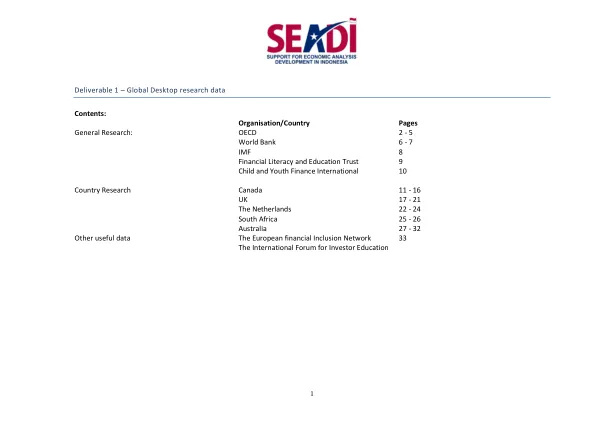
Global Desktop research data: Deliverable 1
The Organisation for Economic Cooperation and Development (OECD) is a 34-member Paris-based organization that promotes economic and social well-being worldwide.
2013 · 33 pages
Sign in to readA free account is required to download.
Abstract
The OECD is actively involved in promoting global financial literacy and education through research and cooperation with member countries. The OECD International Network on Financial Education (INFE) has developed a financial literacy survey instrument, which was piloted in 14 countries last year. The OECD is also conducting a major data gathering exercise in schools across 65 countries to evaluate financial literacy among 15-year-olds. The OECD's definition of financial literacy is "knowledge and understanding of financial concepts, and the skills, motivation, and confidence to apply such knowledge and understanding in order to make effective decisions across a range of financial contexts, to improve the financial well-being of individuals and society, and to enable participation in economic life." The OECD has a dedicated Financial Education program, which includes a global database of financial education programs being run globally. The OECD also hosts conferences and seminars on financial literacy and related topics, such as the upcoming conference in Prague on May 16-17. The World Bank's main aim is to reduce poverty, primarily through capital lending for major projects. Under the Financial and Private Sector Development Division, the World Bank launched a Global Program on Consumer Protection and Financial Literacy in 2010 to help countries achieve "concrete measurable improvements in consumer protection in financial services." The program focuses on four areas: accessible, understandable, and comparable information on financial products; improving business practices to eradicate predatory marketing and increase regulation of intermediaries; promoting means and mechanisms of consumer redress in cases of financial institutions' mistakes; and promoting consumer confidence in using financial services. The World Bank has published several reports on consumer protection and financial literacy, including "Consumer Protection and Financial Literacy Lessons from Nine Country Studies" by Susan L. Rutledge. The report highlights the direct relationship between effective consumer protection and financial literacy levels and recommends that national surveys be conducted every 3-5 years to measure impact and improvements in financial literacy. The World Bank also has an Open Knowledge Repository, where numerous research papers are available as open-source information. The International Monetary Fund (IMF) was established in 1944 by 29 countries to help stabilize the international payment system and exchange rates. Today, it has 188 members and aims to promote international economic cooperation, international trade, employment, and exchange rate stability. The IMF conducts research with member countries that measures all elements contributing to these objectives, including research into "Financial Sector Surveillance" due to its direct correlation with the economic health of a nation and reducing poverty. The IMF has a rich source of detailed technical information that could be useful in developing policies and education programs to promote greater financial literacy. The Financial Literacy and Education Trust is a trust fund established in 2008 by the Russian Federation, the World Bank, and the OECD to support the advancement of financial literacy and capability. The trust fund aims to promote financial education and literacy among individuals, particularly in developing countries.
Related documents