USAID DEC
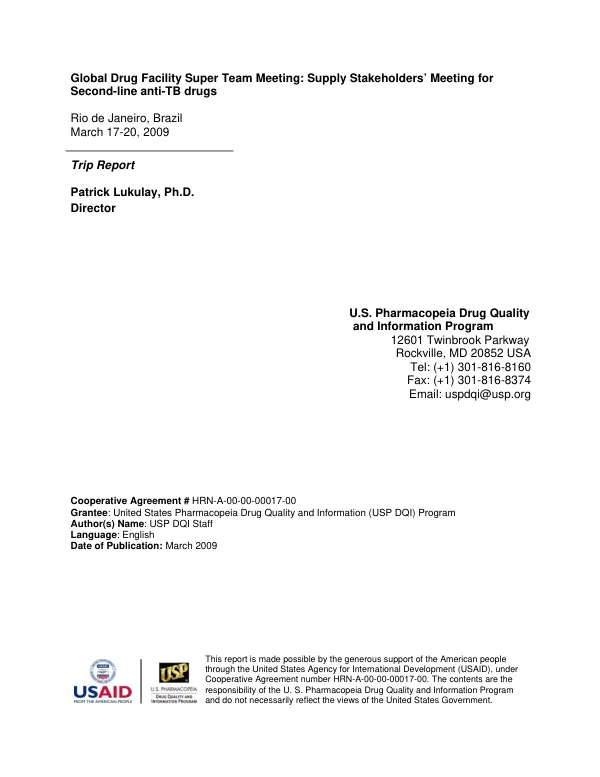
Global Drug Facility Super Team Meeting: Supply Stakeholders’ Meeting for Second-line anti-TB drugs
Sign inTHE GLOBAL FUND TO FIGHT AIDS, TUBERCULOSIS AND MALARIA
Global Drug Facility Super Team Meeting: Supply Stakeholders’ Meeting for Second-line anti-TB drugs
The Global Drug Facility (GDF) Super Team Meeting for Second-line anti-TB drugs was held in Rio de Janeiro, Brazil from March 17-20, 2009.
2009 · 18 pages
Sign in to readA free account is required to download.
Abstract
The meeting aimed to update partners on new initiatives at GDF and the STOP TB secretariat to increase access to first- and second-line anti-tuberculosis (TB) medicines. The conference also engaged manufacturers in discussions about forecast, quantification, and expected procurement plans. USP DQI, a program funded by the U.S. Agency for International Development (USAID), provided technical leadership to the meeting. The program has been working closely with GDF to increase the number of prequalified second-line anti-TB medicines. USP DQI has collaborated with the WHO prequalification team and GDF to provide technical assistance to manufacturers in dossier preparation and on Good Manufacturing Practices (GMP) assessment audits. The USP DQI service to second-line anti-TB drug manufacturers involves providing technical assistance to facilitate the prequalification of second-line anti-TB medicines. This includes reviewing technical literature and providing comments as guidance and recommendations to the Health TB team. USP DQI also works with USP's Documentary Standards Division to develop monographs for first- and second-line anti-TB medicines. GDF ensures access to high-quality drugs at affordable prices for countries in need. Since 2001, GDF has provided anti-TB drugs to 95 countries, including 18 of the 22 countries bearing the highest TB burden. GDF offers various services, including grant services, procurement services, technical assistance, transitional grants, emergency grants, and a strategic stockpile of first- and second-line anti-TB drugs. The USP DQI Trip Report highlights the importance of collaboration between GDF, WHO, and USP DQI in increasing access to high-quality anti-TB medicines. The report also emphasizes the need for early involvement of USP DQI in the prequalification process to ensure the quality of dossiers submitted by manufacturers. The conference provided an opportunity for USP DQI to showcase its services to second-line anti-TB drug manufacturers. The program's collaboration with GDF and WHO has led to the development of criteria for GMP inspections of manufacturers by WHO, resulting in product approval for procurement by GDF. Three manufacturers have responded to the program's services, and the quality of dossiers submitted has improved significantly. The USP DQI service to second-line anti-TB drug manufacturers has been instrumental in increasing access to high-quality anti-TB medicines. The program's collaboration with GDF and WHO has led to significant improvements in the quality of dossiers submitted by manufacturers, resulting in product approval for procurement by GDF. The program's services have also helped to increase the number of prequalified second-line anti-TB medicines, making it easier for countries to access these essential medicines. The conference also highlighted the importance of early involvement of USP DQI in the prequalification process to ensure the quality of dossiers submitted by manufacturers. The program's collaboration with GDF and WHO has led to the development of criteria for GMP inspections of manufacturers by WHO, resulting in product approval for procurement by GDF. The program's services have also helped to increase the number of prequalified second-line anti-TB medicines, making it easier for countries to access these essential medicines. The USP DQI Trip Report concludes that the conference was a success in updating partners on new initiatives at GDF and the STOP TB secretariat to increase access to first- and second-line anti-TB medicines. The conference also engaged manufacturers in discussions about forecast, quantification, and expected procurement plans, highlighting the importance of collaboration between GDF, WHO, and USP DQI in increasing access to high-quality anti-TB medicines.