FHI 360
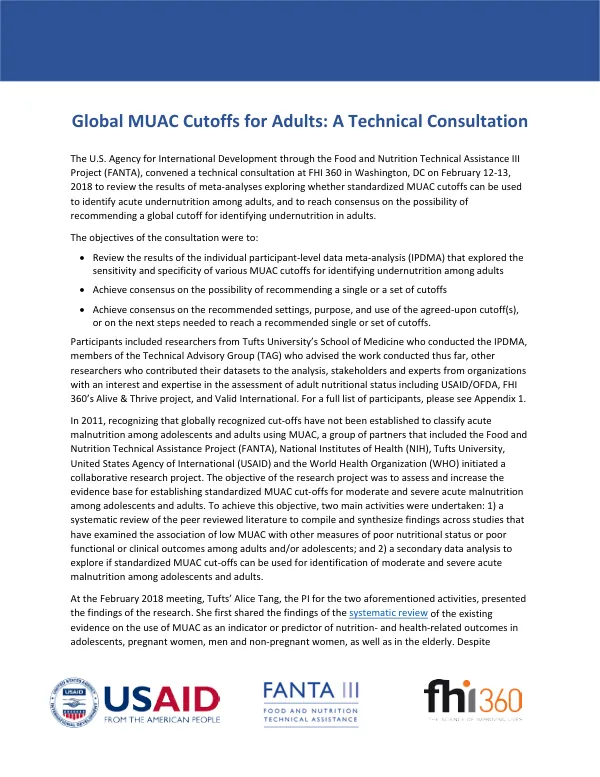
Global MUAC Cutoffs for Adults: A Technical Consultation
The technical consultation on Global MUAC Cutoffs for Adults was convened by the U.S.
2018 · 6 pages
Sign in to readA free account is required to download.
Abstract
Agency for International Development through the Food and Nutrition Technical Assistance III Project (FANTA) at FHI 360 in Washington, DC on February 12-13, 2018. The primary objective of the consultation was to review the results of meta-analyses exploring the use of standardized MUAC cutoffs to identify acute undernutrition among adults and to reach consensus on the possibility of recommending a global cutoff for identifying undernutrition in adults. The consultation brought together researchers from Tufts University's School of Medicine, members of the Technical Advisory Group (TAG), other researchers who contributed their datasets to the analysis, stakeholders, and experts from organizations with an interest and expertise in the assessment of adult nutritional status. The participants included representatives from USAID/OFDA, FHI 360's Alive & Thrive project, and Valid International. The consultation focused on reviewing the results of the individual participant-level data meta-analysis (IPDMA) that explored the sensitivity and specificity of various MUAC cutoffs for identifying undernutrition among adults. The IPDMA found that MUAC cutoffs in the range of ≤23.0 cm to ≤25.5 cm could potentially serve as appropriate indicators for low BMI (<18.5) in the general adult population. The discussion that followed highlighted several issues and concerns regarding the suitability of BMI as a marker of undernutrition in adults, the correlation between BMI and MUAC, and the existence of better proposed functional indicators against which to compare MUAC. The participants also discussed the suitability of using 18.5 as a cutoff for all settings and purposes when BMI is used as the comparator. FANTA's Nutrition Research Technical Advisor, Zeina Maalouf-Manasseh, shared information on MUAC cutoffs for adult undernutrition currently used in 9 African countries for HIV care and management of malnutrition programs. The cutoffs for severe malnutrition used in non-pregnant adults ranged from 16.0 to 21.0 cm, and for moderate malnutrition ranged from 18.0 to 23.0 cm. The consultation ultimately agreed to draft a viewpoint that outlines the consensus reached on the use of MUAC as an indicator for adult undernutrition. The viewpoint highlighted the data gaps that did not allow the group to propose a cutoff, including analysis of the predictive capability of MUAC cutoffs with regards to functional indicators of adult undernutrition and data for pregnant women. The consultation generated momentum around global MUAC cutoffs for adults, and the group recommended that this work move forward with the support of all involved stakeholders. The consultation participants acknowledged the need for further research and analysis to establish standardized MUAC cutoffs for moderate and severe acute malnutrition among adolescents and adults. The technical consultation on Global MUAC Cutoffs for Adults aimed to establish a consensus on the use of MUAC as an indicator for adult undernutrition and to recommend a global cutoff for identifying undernutrition in adults. The consultation brought together experts from various organizations and institutions to review the results of meta-analyses and to discuss the suitability of MUAC cutoffs for adult undernutrition. The consultation highlighted the importance of considering the correlation between BMI and MUAC, the existence of better proposed functional indicators against which to compare MUAC, and the suitability of using 18.5 as a cutoff for all settings and purposes when BMI is used as the comparator. The participants also discussed the need for further research and analysis to establish standardized MUAC cutoffs for moderate and severe acute malnutrition among adolescents and adults. The consultation ultimately agreed to draft a viewpoint that outlines the consensus reached on the use of MUAC as an indicator for adult undernutrition. The viewpoint highlighted the data gaps that did not allow the group to propose a cutoff and recommended that this work move forward with the support of all involved stakeholders.
Related documents