CONSERVATION INTERNATIONAL FOUNDATION
Biodiversity Conservation Advances Global Health Priorities
Biodiversity conservation advances global health priorities by providing essential goods and services that significantly contribute to human health and wellbeing.
2018 · 2 pages
Sign in to readA free account is required to download.
Abstract
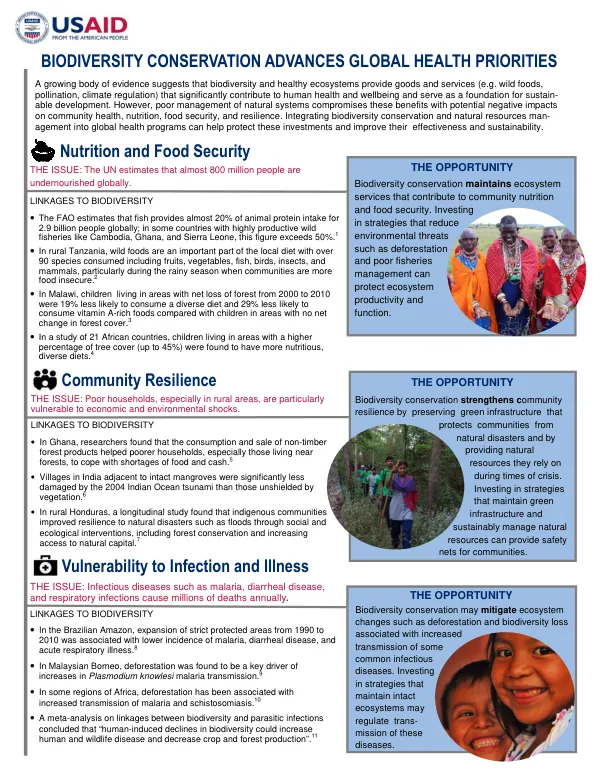
A growing body of evidence suggests that healthy ecosystems offer benefits such as wild foods, pollination, and climate regulation, which are critical for sustainable development. However, poor management of natural systems compromises these benefits, potentially leading to negative impacts on community health, nutrition, food security, and resilience. Infectious diseases such as malaria, diarrheal disease, and respiratory infections cause millions of deaths annually. Research has established linkages between biodiversity loss and increased transmission of these diseases. For instance, a study in the Brazilian Amazon found that expansion of protected areas from 1990 to 2010 was associated with lower incidence of malaria, diarrheal disease, and acute respiratory illness. Similarly, deforestation in Malaysian Borneo was found to be a key driver of increases in Plasmodium knowlesi malaria transmission. In some regions of Africa, deforestation has been associated with increased transmission of malaria and schistosomiasis. Biodiversity conservation may mitigate ecosystem changes such as deforestation and biodiversity loss associated with increased transmission of some common infectious diseases. Investing in strategies that maintain intact ecosystems may regulate transmission of these diseases. A meta-analysis on linkages between biodiversity and parasitic infections concluded that human-induced declines in biodiversity could increase human and wildlife disease and decrease crop and forest production. The issue of undernourishment is a significant global concern, with the UN estimating that almost 800 million people are undernourished globally. Research has established linkages between biodiversity loss and reduced access to nutritious food. For instance, a study in Malawi found that children living in areas with net loss of forest from 2000 to 2010 were 19% less likely to consume a diverse diet and 29% less likely to consume vitamin A-rich foods compared with children in areas with no net change in forest cover. In a study of 21 African countries, children living in areas with a higher percentage of tree cover (up to 45%) were found to have more nutritious, diverse diets. Biodiversity conservation maintains ecosystem services that contribute to community nutrition and food security. Investing in strategies that reduce environmental threats such as deforestation and poor fisheries management can protect ecosystem productivity and function. Community resilience is also strengthened by preserving green infrastructure that protects communities from natural disasters and providing natural resources they rely on during times of crisis. Investing in strategies that maintain green infrastructure and sustainably manage natural resources can provide safety nets for communities.