UNIVERSITY OF MINNESOTA
Government policies and the world food situation
This paper discusses the current and prospective world food situation, how domestic policies affect trade in agricultural products, and how some recent trends in national policies are affecting the global state of affairs with respect to food and agriculture.
Abel, Martin E. · 1970
Sign in to readA free account is required to download.
Abstract
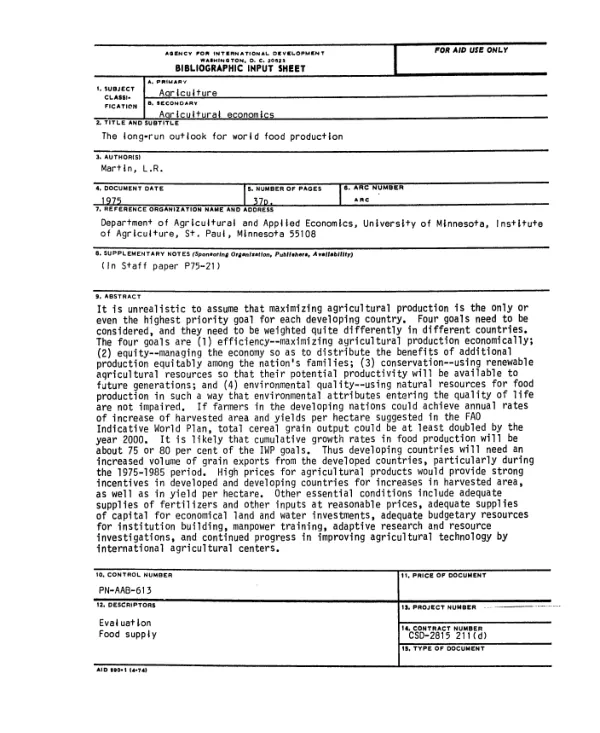
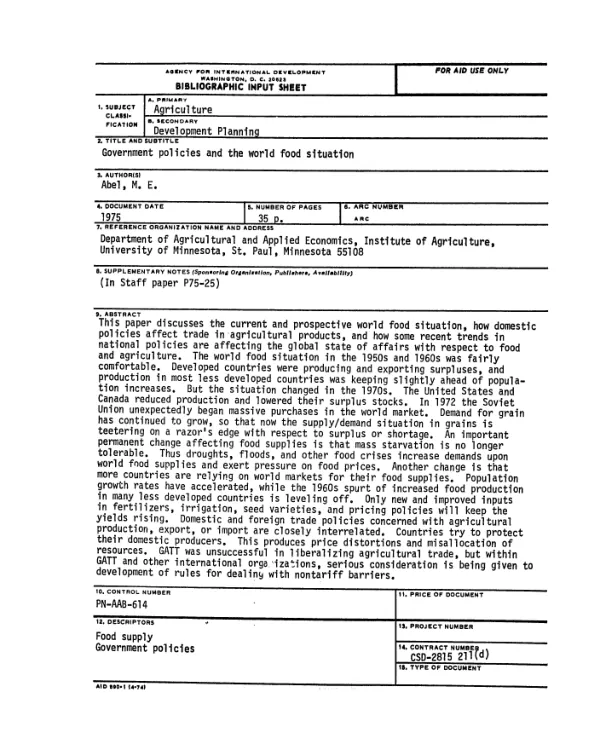
The world food situation in the 1950"s and 1960"s was fairly comfortable. But the situation changed in the 1970"s. The United States and Canada reduced production and lowered their surplus stocks. In 1972, the Soviet Union unexpectedly began massive purchases in the world market. Demand for grain has continued to grow, so that now the supply/demand situation in grains is teetering on a razor"s edge with respect to surplus or shortage. Thus droughts, floods, and other food crises increase demands upon world food supplies and exert pressure on food prices. Another change is that more countries are relying on world markets for their food supplies. Population growth rates have accelerated, while the 1960"s spurt of increased food production in many less developed countries is leveling off. Only new and improved inputs in fertilizers, irrigation, seed varieties, and pricing policies will keep the yields rising. Domestic and foreign trade policies concerned with agricultural production, export, or import are closely interrelated. Countries try to protect their domestic producers. This produces price distortions and misallocation of resources. GATT was unsuccessful in liberalizing agricultural trade, but within GATT and other international organizations, serious consideration is being given to development of rules for dealing with nontariff barriers most countries employ, without requiring abandonment of national food and agricultural policies. Most industrialized countries employ price supports to protect producers and consumers against wide variations in supply and pricing of agricultural products. The net effect of this is to reduce production in countries that compete at world prices, as with Canada and Australia in the case of grains. In many less developed countries, the opposite policy is followed: food prices for urban consumers are kept below world prices, and this depresses producer prices. Also, the protectionist policies followed by most developed countries depress world market prices. This has had serious repercussions for the less developed countries -- mainly reduced incentives to develop their agriculture. Many less developed countries are not producing nearly as much food as they could. However, we do not yet have an adequate empirical base for drawing conclusions about the effects of agricultural policy liberalization in the developed countries. The difficult and long-term nature of agricultural and economic development should be more widely recognized and incorporated into development assistance programs of national governments and international agencies.
Related documents