MEASURE EVALUATION PRH
Graduation Sustainability Assessment Tool for Orphans and Vulnerable Children
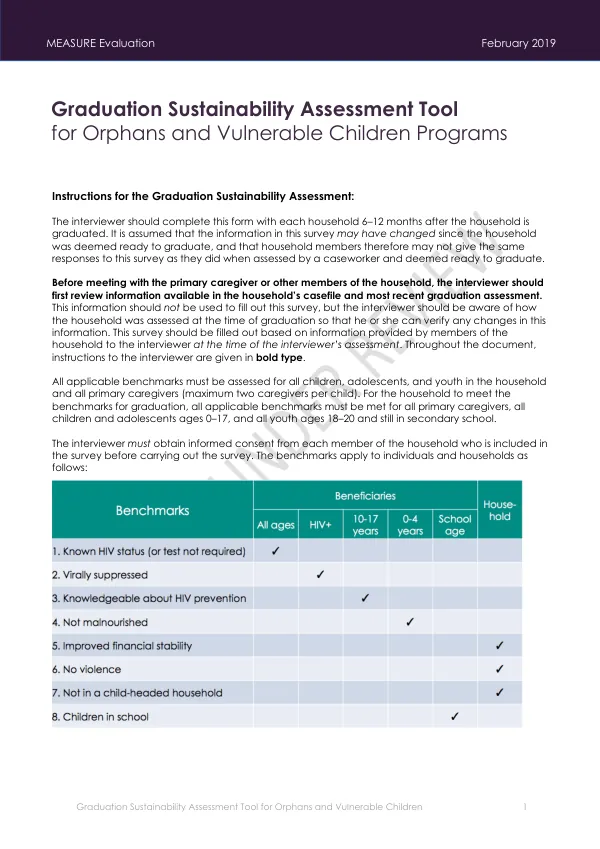
The Graduation Sustainability Assessment Tool for Orphans and Vulnerable Children is a survey designed to assess the sustainability of programs supporting the health and well-being of orphans and vulnerable children.
2019 · 17 pages
Sign in to readA free account is required to download.
Abstract
The tool is intended to be used 6-12 months after a household has been deemed ready to graduate from a program. The assessment is based on information provided by household members to the interviewer. The survey begins with a cover sheet that collects demographic information about the household, including the names and ages of primary caregivers and children. The interviewer must obtain informed consent from each member of the household before proceeding with the survey. The consent form explains the purpose of the survey, the confidentiality of the information, and the voluntary nature of participation. The survey consists of several benchmarks that assess various aspects of the household's well-being. Benchmark 1 evaluates the known HIV status of children, adolescents, and youth in the household, as well as primary caregivers. If all household members have been documented as HIV status positive, negative, or test not required based on risk, Benchmark 1 is met. Benchmark 2 assesses the viral suppression of household members living with HIV. If viral load testing results are available, the beneficiary is considered virally suppressed if their viral load is less than 1,000 copies/mL for the past 12 months. If viral load testing results are not available, caregivers are asked to assess antiretroviral therapy (ART) adherence using a series of questions. If all questions are answered in the negative, the beneficiary is considered to have met Benchmark 2. The survey also includes additional benchmarks that assess various aspects of the household's well-being, including education, economic stability, and social support. The assessment is designed to provide a comprehensive picture of the household's sustainability and identify areas where support may be needed. The Graduation Sustainability Assessment Tool is a critical component of programs supporting orphans and vulnerable children, as it helps to ensure that households are able to sustain their progress and maintain their well-being over time. The tool is designed to be used in conjunction with other assessment tools and data collection methods to provide a comprehensive understanding of program effectiveness. The assessment is typically conducted by a trained interviewer who reviews the household's case file and most recent graduation assessment before meeting with the primary caregiver or other household members. The interviewer must be aware of how the household was assessed at the time of graduation to verify any changes in the information. The survey is designed to be completed in a relatively short period of time, and the information collected is used to improve programs and services for orphans and vulnerable children. The assessment is an essential component of program evaluation and monitoring, as it helps to ensure that programs are meeting their intended goals and making a positive impact on the lives of the children and families they serve.