FHI 360
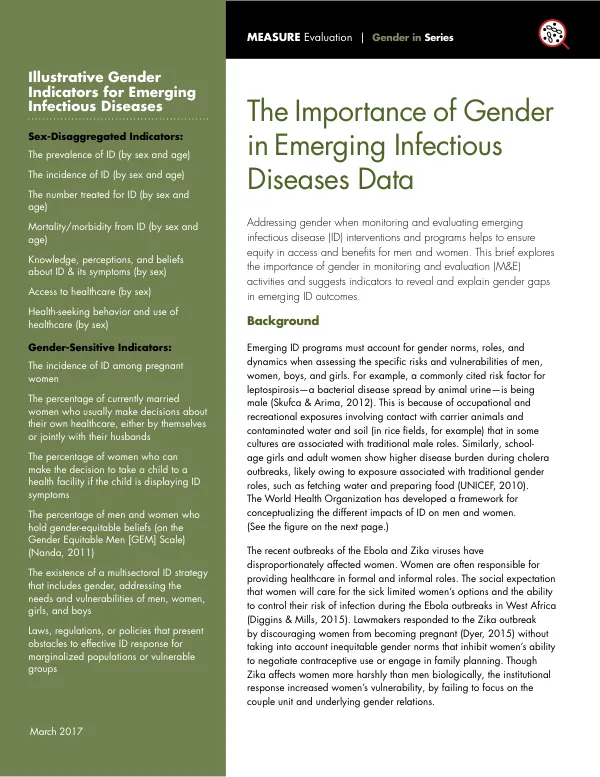
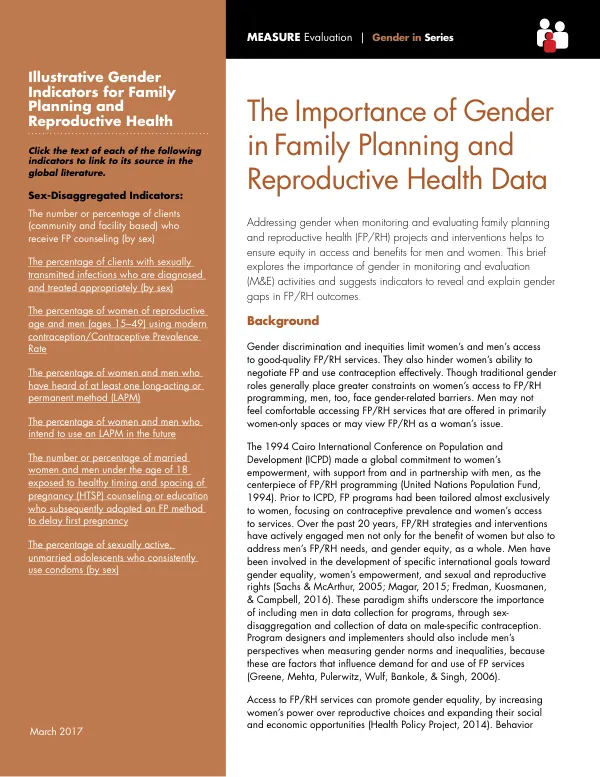
The Importance of Gender in Family Planning and Reproductive Health Data
Addressing gender when monitoring and evaluating family planning and reproductive health (FP/RH) projects and interventions is crucial to ensure equity in access and benefits for men and women.
2017 · 4 pages
Sign in to readA free account is required to download.
Abstract
Gender discrimination and inequities limit women's and men's access to good-quality FP/RH services, hindering women's ability to negotiate FP and use contraception effectively. The 1994 Cairo International Conference on Population and Development made a global commitment to women's empowerment, with support from and in partnership with men, as the centerpiece of FP/RH programming. Prior to ICPD, FP programs had been tailored almost exclusively to women, focusing on contraceptive prevalence and women's access to services. Over the past 20 years, FP/RH strategies and interventions have actively engaged men not only for the benefit of women but also to address men's FP/RH needs and gender equity. Men have been involved in the development of specific international goals toward gender equality, women's empowerment, and sexual and reproductive rights. Program designers and implementers should include men's perspectives when measuring gender norms and inequalities, as these are factors that influence demand for and use of FP services. Access to FP/RH services can promote gender equality by increasing women's power over reproductive choices and expanding their social and economic opportunities. To address gaps in FP/RH outcomes, indicators that specifically address gender are essential. These gender-sensitive indicators make it easier to assess how effectively gender dynamics that negatively influence FP/RH have been addressed. Data from indicators on method availability, uptake, and choice can reveal gender imbalances regarding responsibility for FP. The ability to identify these imbalances has important implications at both a programmatic and country level. The percentage of men and women who share decision making of reproductive health issues with their spouse or sexual partner is an important indicator of gender dynamics in FP/RH. The percentage of men who are supportive of their partner's reproductive health practices and the percentage of men who support the use of modern contraception for themselves or their partners are also critical indicators. The availability of accessible, relevant, and accurate information about sexual and reproductive health tailored to young men is another essential indicator. The existence of an FP/RH strategy that includes gender, addressing the needs and vulnerabilities of men, women, girls, and boys, is a key indicator of effective program implementation. Questions to assess how gender affects FP/RH outcomes include whether there are gender constraints around who has the authority to access FP/RH services, who in the couple makes FP decisions, and whether women need permission to seek a contraceptive method for themselves. The inclusion of men in FP/RH data collection is crucial to understand the specific needs of men, women, boys, and girls across the life cycle. Collection, analysis, and reporting of gender- and age-disaggregated data are critical to fully understand the specific needs of men and women. The U.S. Agency for International Development (USAID) seeks to understand gender differences through M&E activities, both to improve the overall impact of its programs and to ensure that women and men have equitable access to the services they need. FP/RH service providers should be friendly to men, and facilities and community-based providers should facilitate male involvement. Accessible, relevant, and accurate information about FP/RH tailored to young men is essential to promote gender equality and improve FP/RH outcomes. The inclusion of men in FP/RH programming can promote gender equality, improve FP/RH outcomes, and increase access to FP/RH services for men and women.