THE WORLD FOOD PROGRAMME
Grain Marketing Expansion Programme (GMEP) Progress Report
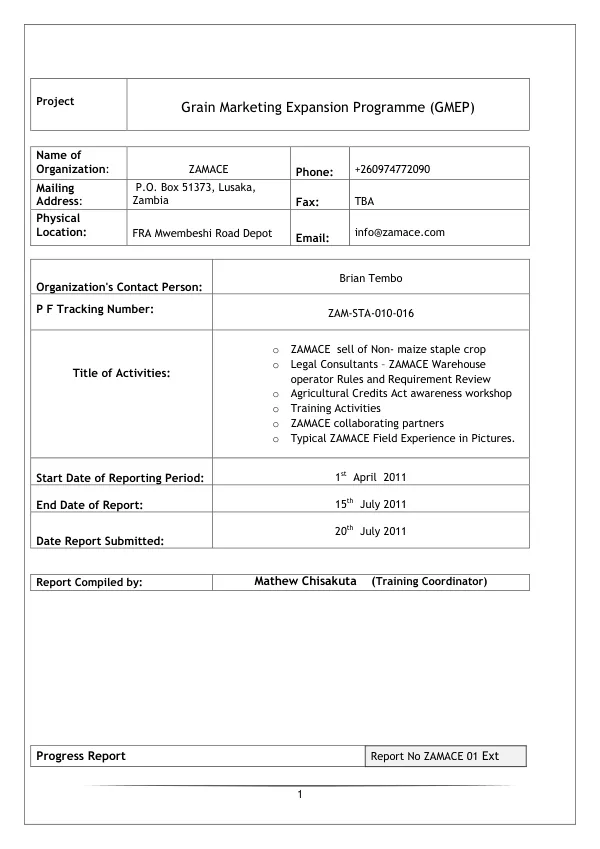
The Grain Marketing Expansion Programme (GMEP) is a project implemented by ZAMACE, a Zambia-based organization, with the goal of expanding grain marketing in the country.
2011 · 10 pages
Sign in to readA free account is required to download.
Abstract
The programme began in April 2011 and was scheduled to conclude in July 2011. The project's main objective is to improve the marketing of non-maize staple crops, such as soya beans, sorghum, and sunflower seeds, by smallholder farmers. To address these challenges, ZAMACE implemented a series of interventions, including farmer training programs, infrastructure development, and market linkage facilitation. The programme focused on establishing a warehouse receipt system, which would enable smallholder farmers to store their produce in certified warehouses and receive payment upon delivery. One of the key achievements of the programme was the successful trade of non-maize staple crops, including soya beans, from smallholder farmers in Mkushi District. A total of 17.09 metric tons of soya beans was traded through the ZAMACE exchange, marking the first successful trade of this type in the region. The programme also established a revolving fund to purchase maize shellers, which improved the quality of post-harvest grain and released family labour previously involved in maize shelling. However, the programme faced several challenges, including the pronouncement of maize purchases by the Food Reserve Agency (FRA), which rendered private commercial buyers unable to fully participate in the marketing season. The FRA's repossession of storage facilities leased to warehouse operators also created distortions in the maize marketing, affecting private commercial traders. Additionally, the enactment of the Agricultural Credits Act 2010 posed a challenge for ZAMACE, as it rendered the current warehouse receipt system illegal until the organization was appointed as an authorized agent. The programme also encountered challenges related to cash on delivery, with many smallholder farmers expecting immediate payment for their produce. This led to traders and millers taking advantage of the situation and discounting commodity prices, making it difficult for farmers to convince them to deliver their produce and wait for payment at a future date. The fear of non-payment was also a major challenge, with farmers having lost crops to dubious businessmen in the past and perceiving aggregation and warehouse usage with suspicion. Despite these challenges, the programme made significant progress in the first quarter, with training activities continuing at ZAMACE head office and in the field. The programme also established new non-maize staple aggregation points and community radio programmes to promote the programme's activities and benefits to smallholder farmers. The programme's next quarter plan includes the establishment of new non-maize staple aggregation points, translations and printing of communication manuals in local languages, and procurement, distribution, and training on maize shellers.