USAID DEC
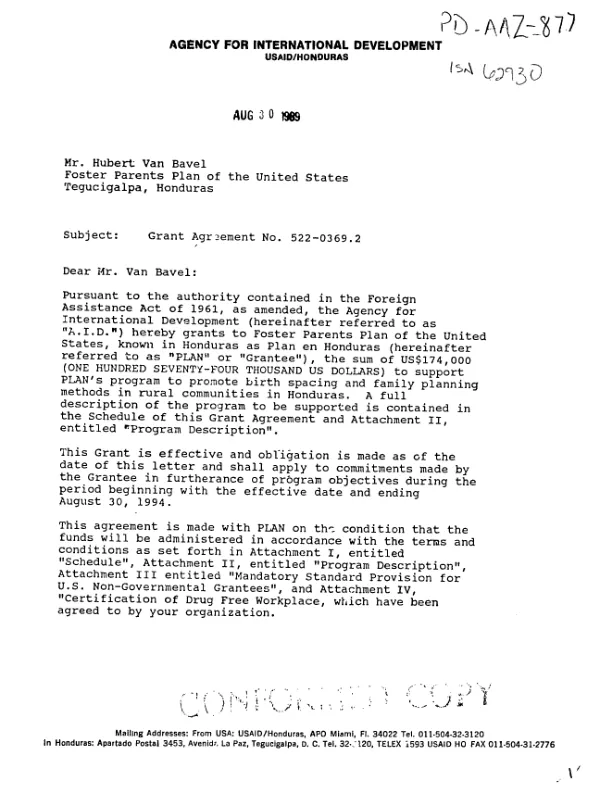
Grant agreement no. 522-0369.2 to Foster Parents Plan of the United States to support a program promoting birth spacing and family planning methods in rural communities in Honduras
Sign inUSAID. MISSION TO HONDURAS
Grant agreement no. 522-0369.2 to Foster Parents Plan of the United States to support a program promoting birth spacing and family planning methods in rural communities in Honduras
Subproject (SP) to support a program of Foster Parents Plan (PLAN) to promote birth spacing and family planning (FP) in rural Honduras.
1989
Sign in to readA free account is required to download.
Abstract
PLAN will collaborate with the Ministry of Health (MOH) and the Honduran FP Association (ASHONPLAFA) in implementing the SP in some 400 communities in 8 PLAN-served areas (Cedros, San Jeronimo, Guiamaca, Siguatepeque, Villa de San Francisco, Masaguara, La Paz, and Salama). In promoting FP, the benefits of birth spacing (using both natural and artificial means) for child survival and maternal health will be stressed, especially for women at high reproductive risk (women under 18, over 35, or who have had 3 or more births). The nutritional benefits of breastfeeding will also be emphasized. PLAN will obtain free promotional materials, geared to the illiterate population, from ASHONPLAFA and the MOH. In addition, 350 schoolteachers will be trained to include sex education and family life and breastfeeding topics in the sixth grade curriculum; this training will be provided by ASHONPLAFA trainers or by PLAN trainers in collaboration with Peace Corps volunteers. About 80% of SP efforts will be devoted to training community and institutional personnel to provide FP services, promote breastfeeding, and make FP referrals for women at high reproductive risk. This training will include: (1) workshops for 80 PLAN promoters and 8 regional coordinators; (2) training of 40 MOH doctors and 20 nurses in 8 rural health clinics, complemented by the provision of free IUD kits to doctors; and (3) training of community health representatives, midwives, and health guardians in the 400 PLAN villages to provide FP information and referrals and distribute contraceptives, serving in all some 14,000 women of fertile age. PLAN will also help women to organize breastfeeding and birth spacing support groups. PLAN will supplement ASHONPLAFA"s contraceptive distribution system by increasing the number of village FP posts from 125 to 300; condoms and orals will be sold at the FP posts and through community health workers in areas not served by ASHONPLAFA. Finally, PLAN will formalize the system by which community health workers refer clients to the MOH and ASHONPLAFA by providing the workers with official referral forms and by maintaining a record of referrals. Some 2,400 women at high reproductive risk will be referred for surgical contraception during the SP"s 5-year life.