AFGHAN MINISTRY OF RURAL REHABILITATION AND DEVELOPMENT
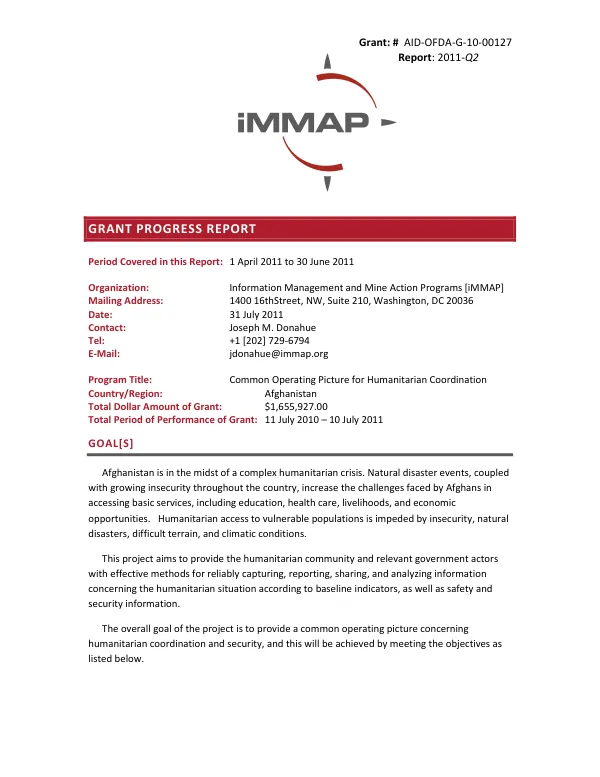
Grant Progress Report: 2011-Q2 for AID-OFDA-G-10-00127
The Common Operating Picture for Humanitarian Coordination project in Afghanistan aims to provide the humanitarian community and relevant government actors with effective methods for capturing, reporting, sharing, and analyzing information concerning the humanitarian situation.
2011 · 14 pages
Sign in to readA free account is required to download.
Abstract
The project, funded by the United States Agency for International Development (USAID) Office of U.S. Foreign Disaster Assistance (OFDA), began on July 11, 2010, and is scheduled to conclude on July 10, 2011. The project's overall goal is to provide a common operating picture concerning humanitarian coordination and security. To achieve this goal, the project has several objectives, including improving the safety and security of humanitarian field operators, enhancing and integrating current databases of humanitarian projects and activities, and providing a common operating picture of humanitarian data and baseline indicators of the humanitarian situation. iMMAP, the organization implementing the project, has maintained its OASIS system in Afghanistan since 2009. As of March 31, 2011, OASIS is used by 59 organizations with more than 170 OASIS installations, and approximately 150 trained OASIS users. On average, iMMAP has between three and four new clients, approximately ten OASIS installations, and five newly trained OASIS users every month. The project has made significant progress in providing information management support to the coordination mechanism among three Cluster groups directly involved in relief operations for drought emergency response. These Cluster groups include the Food Security and Agriculture Cluster, the Early Warning Information Working Group, and the Nutrition Cluster. iMMAP is also providing information management support to other Clusters, including the WASH Cluster, the Education Cluster, and the Shelter Cluster. In addition, the project has identified the need for two additional information management consultants to provide a detailed needs assessment of information management requirements among OFDA partners and other humanitarian organizations working in the field. The consultants will provide a detailed report highlighting database developments and enhancements that will be useful to field agencies. The project's progress has been significant, with OASIS being used by 59 organizations with more than 170 OASIS installations, and approximately 150 trained OASIS users. The project has also made available new datasets obtained and made available to clients via maps and OASIS, including coordination mechanism information products, food security and agriculture cluster information products, and nutrition cluster information products. The project's success has been attributed to the collaboration and coordination among various stakeholders, including the humanitarian community, government actors, and local authorities. The project's continued support is essential to maintain the momentum gained in the first few months of the OFDA grant and to continue providing support to the humanitarian community and relevant government stakeholders. The project's impact has been significant, with the provision of a common operating picture concerning humanitarian coordination and security. The project has improved the safety and security of humanitarian field operators, enhanced and integrated current databases of humanitarian projects and activities, and provided a common operating picture of humanitarian data and baseline indicators of the humanitarian situation.