AFGHANISTAN MINISTRY OF AGRICULTURE, IRRIGATION AND LIVESTOCK
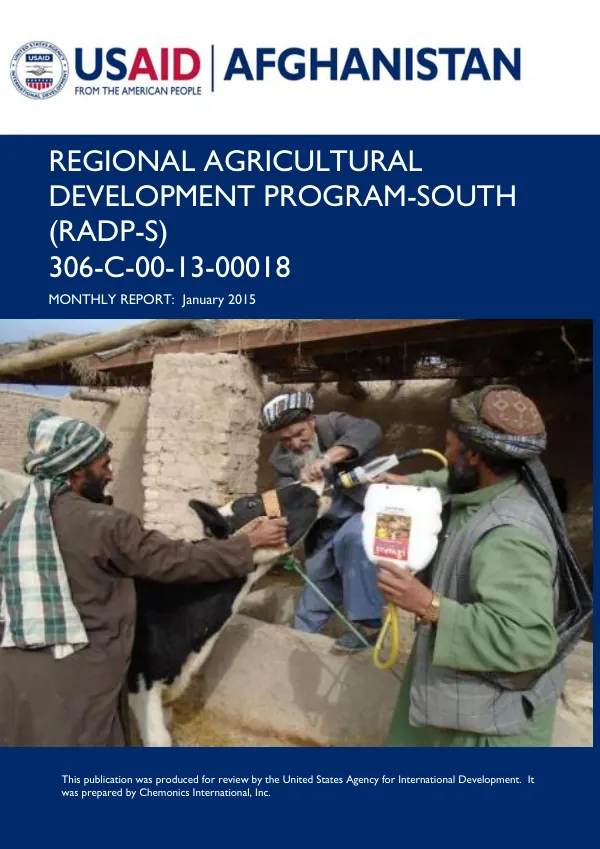
Regional Agricultural Development Program-South January 2015 Monthly Report
The Regional Agricultural Development Program-South (RADP-S) aims to improve food and economic security for rural Afghans in the provinces of Kandahar, Helmand, Zabul, and Uruzgan.
2015 · 10 pages
Sign in to readA free account is required to download.
Abstract
The program focuses on improving the productivity and profitability of the wheat, high value crops, and livestock value chains, while addressing policy, legal, and regulatory constraints affecting value chain development. RADP-S supports the consolidation of licit economies to fuel sustainable long-term economic growth, including providing alternatives to poppy cultivation. The implementation approach of RADP-S dovetails with Afghan and U.S. government strategies in its focus on advancing food security, regenerating agribusiness, and increasing agriculture sector jobs and incomes. RADP-S aims to strengthen the capacity of producers, associations, traders, and agribusinesses to respond to market demands; facilitate lasting market linkages between value chain actors; and support an enabling environment that allows the private sector to thrive. The program places the Afghan private sector at the forefront of implementation and addresses key cross-cutting issues of women's empowerment, agribusiness value chain facilitation, and alternative development in all facets of the program. In January, the Productivity and Production Unit (PPU) continued to facilitate wheat and high value crops (HVC) trainings to farmers in 15 target districts across Kandahar, Helmand, Uruzgan, and Zabul province. A total of 5,932 farmers attended trainings in Kandahar, Helmand, Uruzgan, and Zabul province during the month. The trainings covered topics such as wheat integrated pest management (IPM) and weed control, orchard establishment, greenhouse IPM and weed control, and vineyard establishment. The value chain facilitation unit (VCFU) followed up with four companies that participated in the Kabul AgFair in September 2014. The VCFU was able to capture data for business deals that resulted from the companies' participation at the AgFair, which was an opportunity for Afghan companies in agricultural-related value chains to increase publicity, identify new customers, network with potential business partners, and share information. As a result of the AgFair, the four companies brokered new business deals worth an estimated $67,950. In January, the RADP-S outreach team made steps to initiate an SMS and Interactive Voice Response (IVR) outreach campaign. In partnership with Equal Access, RADP-S identified mobile service provider Roshan to establish a mobile platform from which RADP-S would be able to send SMS messages to farmers. The IVR system would allow for farmers/listeners to subscribe after providing basic demographic information. Subscribers would also be able to access the information through an online portal. Based on where farmers reside and what crops they cultivate, the IVR system would distribute agricultural information and tips on a weekly basis. The PPU continued to provide capacity building to Key Implementing Partners (KIPs) and conducted week-long site visits to KIP offices in Kandahar, Helmand, Uruzgan, and Zabul. During the site visits, PPU staff met with KIP staff to discuss program implementation, provide technical assistance, and identify areas for improvement. The PPU also provided training to KIP staff on topics such as project management, monitoring and evaluation, and communication. The RADP-S program has made significant progress in improving the productivity and profitability of the wheat, high value crops, and livestock value chains in the provinces of Kandahar, Helmand, Zabul, and Uruzgan. The program has trained over 5,932 farmers in wheat and HVC topics, and has facilitated business deals worth an estimated $67,950 through the Kabul AgFair. The program has also initiated an SMS and IVR outreach campaign to provide agricultural information and tips to farmers on a weekly basis.