USAID DEC
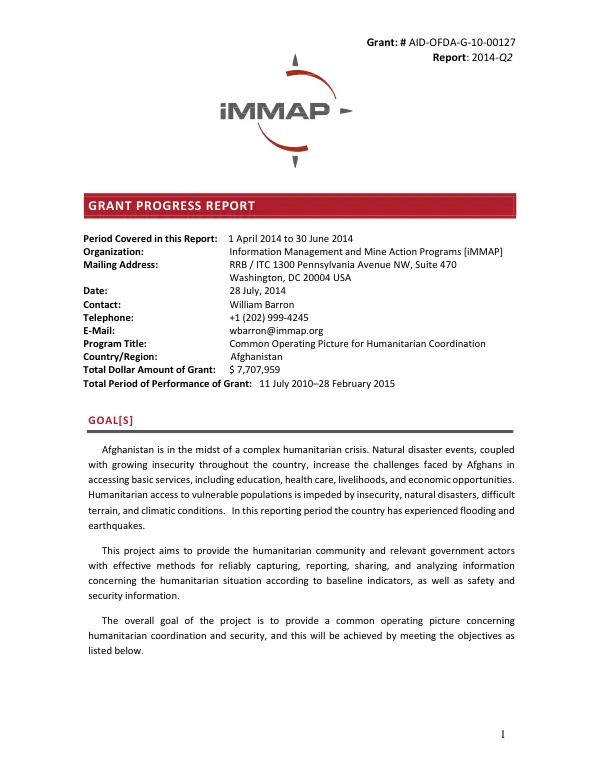
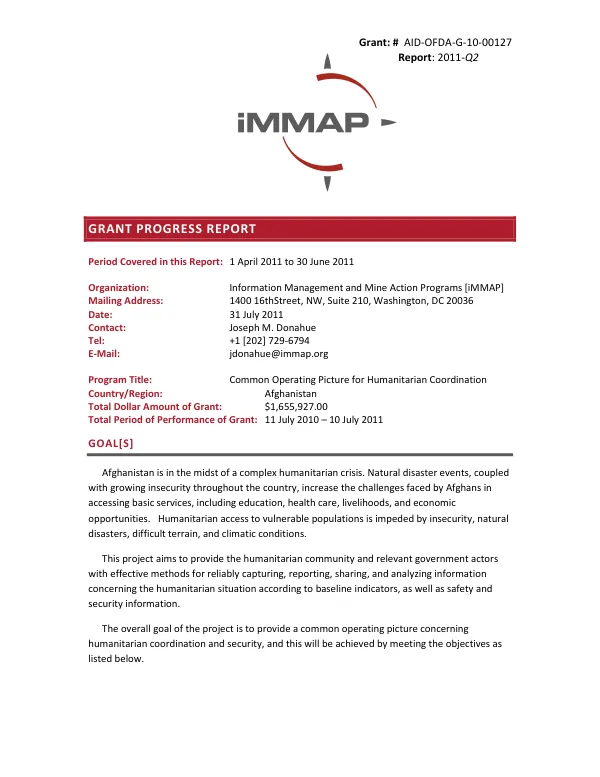
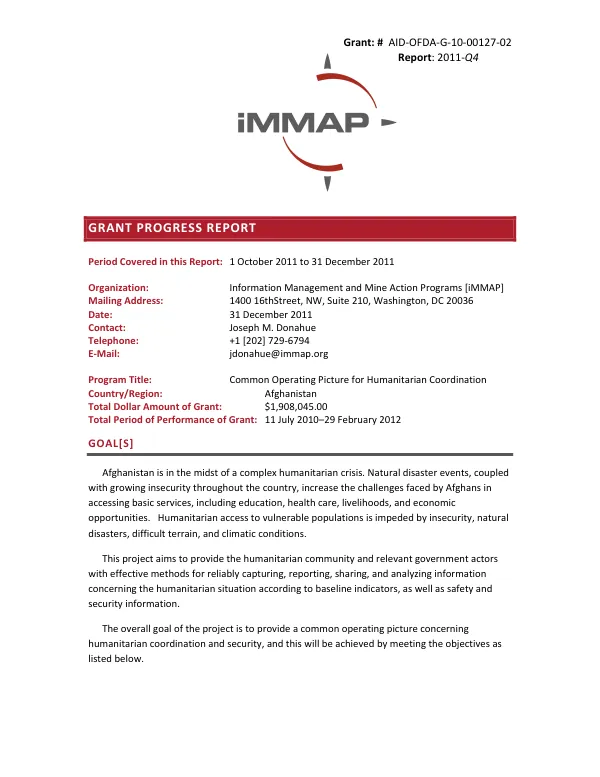
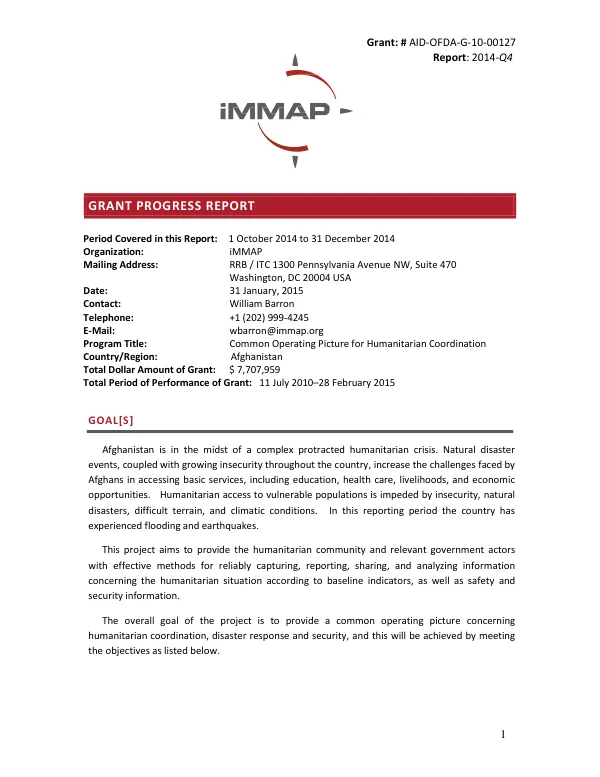
Grant Progress Report: Common Operating Picture for Humanitarian Coordination in Afghanistan
Sign inMINISTRY OF PUBLIC HEALTH
Grant Progress Report: Common Operating Picture for Humanitarian Coordination in Afghanistan
The Common Operating Picture for Humanitarian Coordination project in Afghanistan aims to provide the humanitarian community and relevant government actors with effective methods for capturing, reporting, sharing, and analyzing information concerning the humanitarian situation.
2015 · 17 pages
Sign in to readA free account is required to download.
Abstract
The project is funded by the United States Agency for International Development (USAID) through the Office of U.S. Foreign Disaster Assistance (OFDA) with a total dollar amount of $7,707,959. The project's overall goal is to provide a common operating picture concerning humanitarian coordination, disaster response, and security. To achieve this goal, the project has several objectives, including improving the safety and security of humanitarian field operators, enhancing and integrating current databases of humanitarian projects and activities, and providing a common operating picture of humanitarian data and baseline indicators of the humanitarian situation. iMMAP has maintained its OASIS system in Afghanistan since 2009, which is used by 79 organizations with 171 installations and approximately 153 trained users. The system is being phased out due to its older technology and is being migrated to web-based tools. During the reporting period, 50 new maps were created, 398 hardcopy maps were distributed, and 31 new maps were posted to the iMMAP website. The project has provided information management support to various humanitarian clusters, including the Nutrition Cluster, Protection Cluster, Health Cluster, Education Sector, and Inter-cluster groups working on Disaster Risk Reduction. Examples of the work undertaken during the reporting period include the development of a web-based database for the Nutrition Surveillance System, data cleaning for over 10,000 records provided by the Ministry of Public Health, and the production of over 200 district maps for a participative mapping exercise. iMMAP has also provided common information management services to 79 organizations, with 171 installations and approximately 153 trained users. The organization has a total of 185 datasets, of which 155 are available for free public access and 30 have restricted access due to social protection procedures and copyrights on the data. The datasets are regularly evaluated for quality, and discrepancies are addressed through bilateral discussions with the data source. The project has made significant progress in providing a common operating picture for humanitarian coordination in Afghanistan. The information management support provided to various humanitarian clusters has improved the humanitarian community's overall situational knowledge, response, planning, decision-making, and coordination. The project's objectives are being met, and the humanitarian community is benefiting from the information management services provided by iMMAP. The project's geographic focus is Afghanistan, and the timeframes for the project are from July 2010 to February 2018. The recommendations for the project include continuing to provide information management support to the humanitarian community, enhancing the quality of the datasets, and migrating the OASIS system to web-based tools.