USAID. BUR. FOR PRIVATE ENTERPRISE. OFC. OF PROJECT DEVELOPMENT
Grant to the International Executive Service Corps
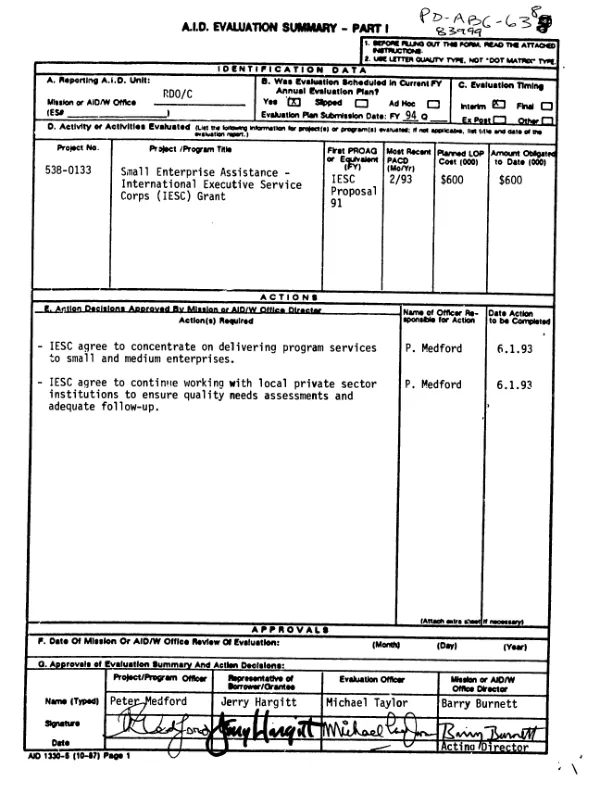
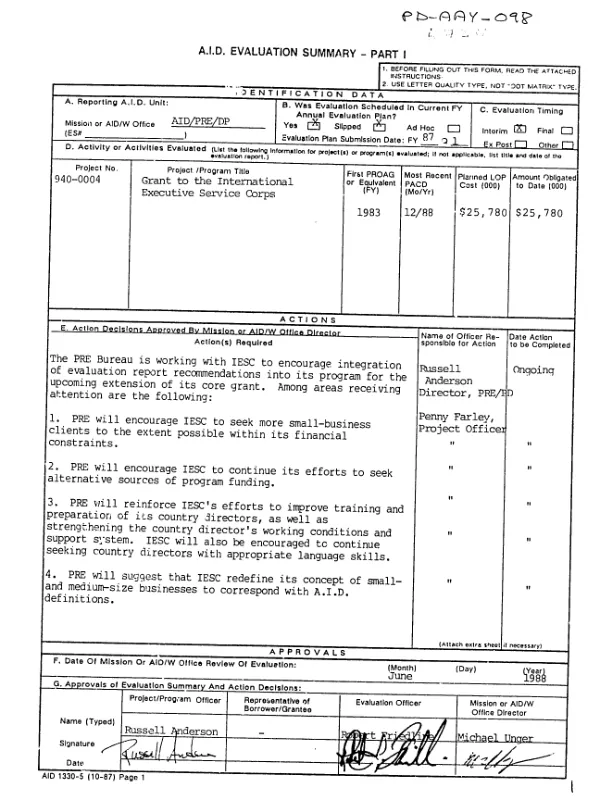
Summarizes attached evaluation (XD-AAY-098-A) of a grant to supply core funding to the International Executive Service Corps" (IESC) program to provide business and management expertise in LDC"s.
1988
Sign in to readA free account is required to download.
Abstract
The evaluation was based largely on field interviews with 197 IESC clients in 11 countries and was held to provide input for a forthcoming renewal of the grant and to aid other A.I.D. offices in decisionmaking regarding IESC. Major findings are as follows. (1) In perceived impact, IESC"s technical assistance rates higher than its management assistance, possibly because the latter takes longer to show benefit. (2) Clients generally rated IESC"s assistance highly. In over 60% of completed cases, clients were "highly satisfied" and in another 24% they were "mostly satisfied." Ratings for IESC"s volunteer executives were especially positive. (3) A.I.D."s efforts to target specific clients have created some competition among IESC mandates, particularly between efforts to target smaller, poorer clients and pressures to reduce spending. (4) Client complaints had to do with the selection and skills of volunteers and relationships with IESC country directors. While it proved difficult to convert the large amount of data on IESC cases into quantitative impact indicators, the evaluation produced a number of impact variables. The most important of these was IESC"s ability to provide an experienced, enthusiastic volunteer. Other determinants of impact were the volunteer"s support system, including the background and business approach of the IESC country director; the clarity and accuracy of the original request for assistance; and the existence of a suitable counterpart within the assisted business. The evaluation concluded that IESC operates within a framework of policies, practices, and pressures which will determine its future options. Key factors are: (1) IESC"s ability to deliver a unique product - carefully targeted, highly personalized short-term assistance from an experienced volunteer (though this approach may become less relevant to LDC needs in the next decade); (2) high regard for IESC in many LDC"s, along with the confidence that IESC provides top-quality help free from pressure to "buy American;" (3) a business strategy which focuses mainly on getting the volunteer to the work site and less on prior project design or the achievement of externally defined objectives (also possibly of declining importance); (4) an overseas management structure based on short-term, near-volunteer directors mainly concerned with marketing IESC assistance; and (5) a complex funding situation in which income is partially derived from government subsidies which are uncertain from year to year. Major recommendations involve strengthening the position of country director and finding ways to increase IESC"s income from non-A.I.D. sources.