USAID DEC
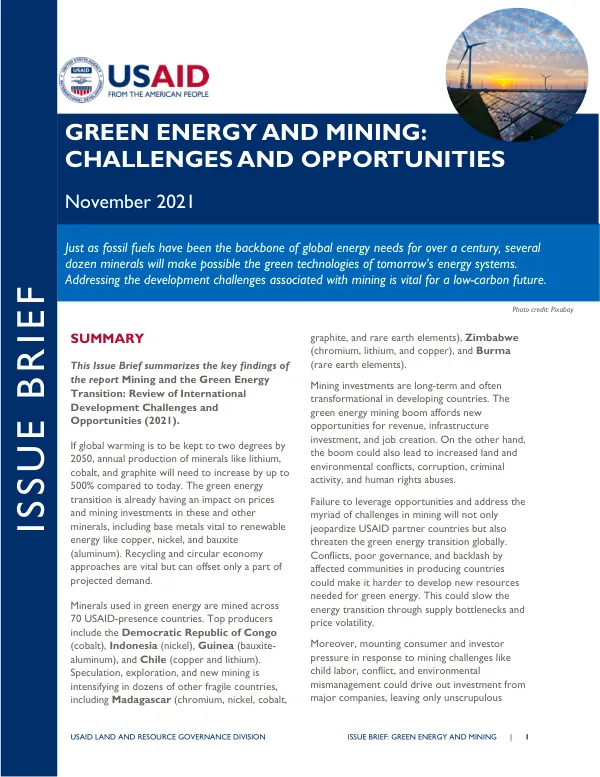
Green Energy and Mining: Challenges and Opportunities
The green energy transition is expected to significantly increase the demand for minerals such as lithium, cobalt, and graphite.
2021 · 4 pages
Sign in to readA free account is required to download.
Abstract
According to a report, annual production of these minerals will need to increase by up to 500% by 2050 to keep global warming to two degrees. The green energy transition is already affecting prices and mining investments in these and other minerals, including base metals vital to renewable energy like copper, nickel, and bauxite (aluminum). Minerals used in green energy are mined across 70 countries where USAID has a presence. The top producers of these minerals include the Democratic Republic of Congo (cobalt), Indonesia (nickel), Guinea (bauxite-aluminum), and Chile (copper and lithium). Speculation, exploration, and new mining are intensifying in dozens of other fragile countries, including Madagascar (chromium, nickel, cobalt, graphite, and rare earth elements), Zimbabwe (chromium, lithium, and copper), and Burma (rare earth elements). Mining investments are long-term and often transformational in developing countries. The green energy mining boom presents new opportunities for revenue, infrastructure investment, and job creation. However, it also poses challenges such as increased land and environmental conflicts, corruption, criminal activity, and human rights abuses. Failure to address these challenges could jeopardize USAID partner countries and threaten the global green energy transition. The report highlights the importance of addressing the development challenges associated with mining for a low-carbon future. Securing minerals for green energy requires a whole-of-supply-chain approach, considering China's dominance in mineral processing and manufacturing, and the growing involvement of both processors and manufacturers in mining investments and standard-setting. Attention to and support of community- and country-level dynamics are critical in both major producing countries and smaller emerging producers likely to be heavily impacted by the coming mining boom. Development partners have often shied away from mining programming, but this is no longer a feasible option. USAID can draw on its rich cross-sectoral experience addressing mining's development challenges across several dozen projects worldwide. More explicit consideration of mining in country-level programming and multi-sectoral inter-agency approaches to climate change and green energy will help reduce risks for partner countries and leverage opportunities afforded by increased mineral demand. The report identifies several key green energy minerals with the highest projected demand increases by 2050, including graphite (494%), lithium (488%), cobalt (460%), vanadium (189%), nickel (99%), silver (56%), and rare earth elements (37%). The report also highlights the challenges and key USAID-presence producers associated with these minerals, including the Democratic Republic of Congo (cobalt), Chile (lithium), and Indonesia (nickel). The report emphasizes the need for a comprehensive approach to address the development challenges associated with green energy mining. This includes policy dialogue, governance capacity-building, and reform, transparency and anti-corruption, environmental and social risk management, and formalization of artisanal and small-scale mining. The report also highlights the importance of considering the whole-of-supply-chain approach, including mineral processing and manufacturing, and the growing involvement of both processors and manufacturers in mining investments and standard-setting.