USAID
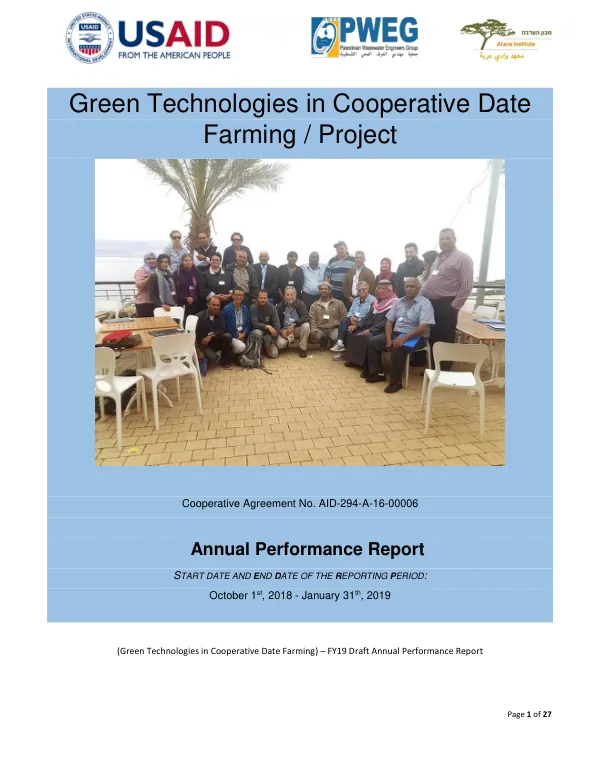
Green Technologies in Cooperative Date Farming FY19 Annual Performance Report
The Green Technologies in Cooperative Date Farming project aims to advance cooperation and coexistence among Israeli and Palestinian date farmers in the Jordan and Arava Valleys by promoting innovative and sustainable solutions to meet water, energy, and economic needs.
2019 · 27 pages
Sign in to readA free account is required to download.
Abstract
The project addresses the need for conflict mitigation with respect to trans-boundary environmental management between Israel and the West Bank. This innovative project recognizes that water, food, and energy resources play important roles in the Israeli-Palestinian conflict and will implement on-site and off-grid resource solutions for mitigating environmental conflicts. The project will engage Israeli and Palestinian farmers/packers, community leaders, and students and researchers in a series of people-to-people (P2P) activities to implement integrated water, energy, and food systems for enhanced date production in both regions. The project will enable Palestinian and Israeli stakeholders to engage with one another on appropriate local solutions for their water and energy needs, and improve the capacity of the agricultural sectors in the Jordan and Arava Valleys. The project has three main objectives: 1. Project innovative and sustainable solutions meeting targeted Israeli/Palestinian farmer's water, energy, and economic needs implemented. 2. Develop integrated system combining sustainable energies for pumping water and wastewater treatment and reuse to improve and increase date production. 3. Al Auja and Marj Al-Ghazal Palestinian farmers' capacity in date production, storage, marketing, and promotion strengthened. To achieve these objectives, the project will establish a joint Palestinian-Israeli Jordan-Arava Valley Committee (JAV) with 20 Palestinian and Israeli members, with a minimum of 35% females. The committee will work towards formalizing relations between the two regions and develop a joint project for renewable energy and water needs in the two areas. During the reporting period of October 1, 2018, to January 31, 2019, the project made significant progress in establishing the JAV committee. The target was to have 20 Palestinian and Israeli members, with a minimum of 35% females, and the actual number achieved was 23 members, with 30% females. The committee has 15 Palestinian members and 8 Israeli members, with a minimum of 30% females. The project also conducted Uni JAV meetings and consultations with partners, beneficiaries, and stakeholders to discuss the project's progress and future plans. The meetings aimed to ensure effective collaboration and coordination among the project's stakeholders and to address any challenges or concerns that may arise. The project's implementation plan for the reporting period included several activities, including the establishment of the JAV committee, the development of a joint project for renewable energy and water needs, and the implementation of people-to-people activities to promote cooperation and coexistence among Israeli and Palestinian date farmers. The project's progress in the reporting period was satisfactory, and the project is on track to achieve its objectives. However, the project faced some challenges, including the need to address the political and security situation in the region and to ensure the safety and security of the project's staff and beneficiaries. The project's future plans include the continuation of the JAV committee's activities, the implementation of the joint project for renewable energy and water needs, and the expansion of the project's scope to include other areas of cooperation and coexistence among Israeli and Palestinian farmers. The project will also continue to engage with local partners and stakeholders to ensure effective collaboration and coordination among the project's stakeholders. The project's impact on the region will be significant, as it will promote cooperation and coexistence among Israeli and Palestinian farmers, improve the capacity of the agricultural sectors in the Jordan and Arava Valleys, and address the need for conflict mitigation with respect to trans-boundary environmental management between Israel and the West Bank. The project will also contribute to the development of sustainable and innovative solutions to meet water, energy, and economic needs in the region.