FOOD AND AGRICULTURE ORGANIZATION OF THE UNITED NATIONS IN GEORGIA
Greenhouse Gas Emissions in East Africa
The East Africa region is home to eight countries, including Burundi, Central African Republic, Democratic Republic of Congo, Djibouti, Ethiopia, Kenya, Rwanda, and Tanzania.
2015 · 8 pages
Sign in to readA free account is required to download.
Abstract
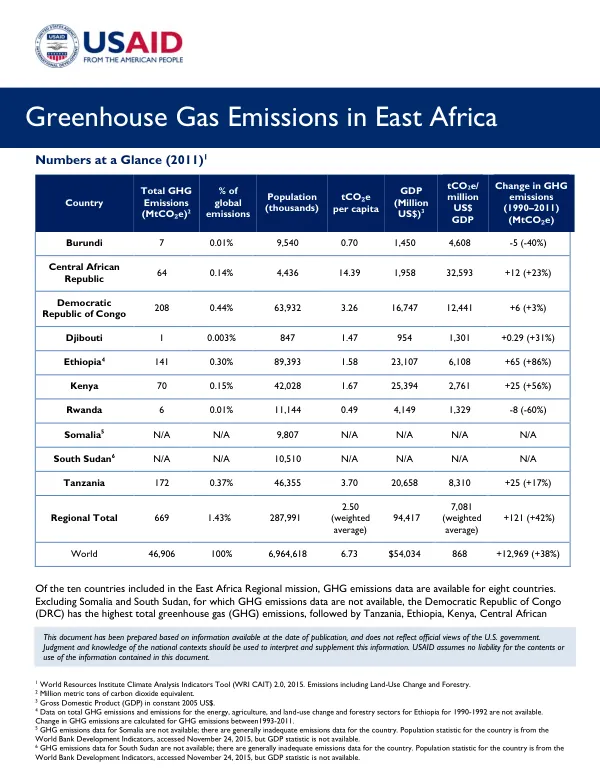
These countries are responsible for 1.43% of global greenhouse gas (GHG) emissions. On a per capita basis, the region's emissions are 2.5 times below the world average, with the exception of the Central African Republic, where per capita emissions are more than twice the world average. The region's GHG emissions are primarily from the land-use change and forestry (LUCF) and agriculture sectors. Together, these two sectors are responsible for 81% of total regional GHG emissions, with LUCF accounting for nearly half and agriculture nearly a third. The energy sector is the region's third highest emitting sector, accounting for 10% of total regional emissions. Emissions from waste and industrial processes are relatively insignificant. The total GHG emissions of the countries in the East Africa region increased 42% from 1990 to 2011. The Democratic Republic of Congo has the highest total GHG emissions, followed by Tanzania, Ethiopia, Kenya, and the Central African Republic. Burundi and Rwanda have seen a decrease in GHG emissions, with a 40% and 60% reduction, respectively. The decrease in emissions in these countries is attributed to activities in the LUCF sector, including the prohibition of bush fires and the implementation of a national reforestation policy in Burundi, and the preservation of nature reserves and park areas in Rwanda. The LUCF sector is the leading source of GHG emissions in Burundi, the Democratic Republic of Congo, and Tanzania. The Democratic Republic of Congo has a historically low rate of deforestation, attributed to underdeveloped infrastructure, low population density, and the availability of large swathes of non-forestland. However, the country's large forest area equates to a substantial source of GHG emissions. Deforestation in the Democratic Republic of Congo is driven by infrastructure development, agricultural expansion, and the activities of extractive industries. In contrast, Tanzania has a higher deforestation rate, driven by the expansion of agricultural land, energy needs, and commercial logging. The agriculture sector is the region's second highest GHG emitting sector, with enteric fermentation being the top emitting agriculture subsector in Ethiopia, Tanzania, and Kenya. In the Central African Republic and Democratic Republic of Congo, enteric fermentation and the top emitting subsector, respectively. The key countries in terms of emissions volume are Ethiopia, Tanzania, Kenya, the Central African Republic, and the Democratic Republic of Congo, whose emissions make up 89% of the region's agriculture GHG emissions.
Related documents