PACT
Regional Program Overview: USAID/East Africa
The U.S.
2015 · 2 pages
Sign in to readA free account is required to download.
Abstract
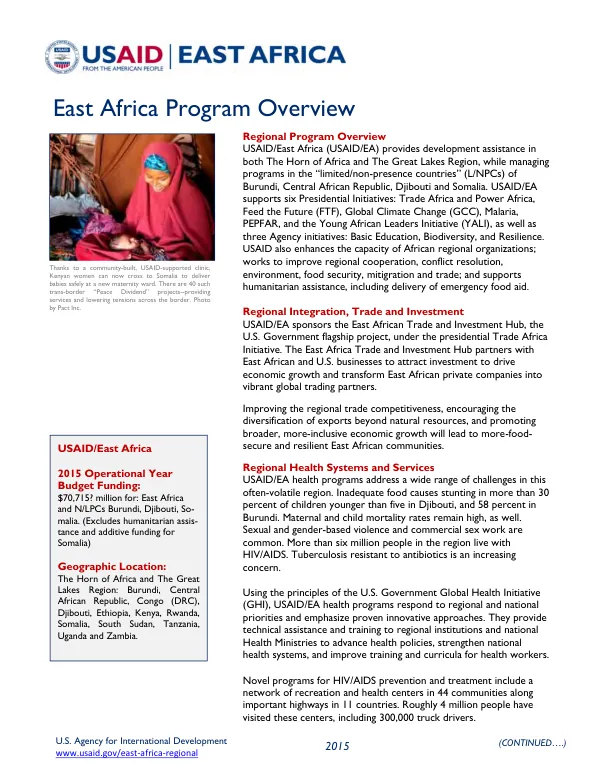
Agency for International Development (USAID) East Africa Regional Mission operates in both The Horn of Africa and The Great Lakes Region, managing programs in "limited/non-presence countries" (L/NPCs) of Burundi, Central African Republic, Djibouti, and Somalia. USAID/EA supports six Presidential Initiatives: Trade, Power Africa, Feed the Future, Global Climate Change, Malaria, and the Young African Leaders Initiative, as well as three Agency initiatives: Basic Education, Biodiversity, and Resilience. Regional Integration, Trade, and Investment are key areas of focus for USAID/EA. The East African Trade and Investment Hub, a flagship program, aims to attract investment to drive economic growth and transform East African private companies into vibrant global partners. The program promotes regional trade competitiveness, export diversification beyond natural resources, and broader, more-inclusive economic growth. Regional Health Systems and Services are also a priority for USAID/EA. Inadequate nutrition causes stunting in over 30% of children under five in Djibouti and 58% in Burundi. Maternal and child mortality rates remain high, and sexual and gender-based violence is common. USAID/EA health programs address these issues by providing technical assistance and training to regional institutions and national Health Ministries. They also establish networks of health centers and provide novel programs for HIV/AIDS prevention. The East Africa Program Overview highlights the geographic location of USAID/EA's operations, which includes The Horn of Africa and The Great Lakes Region, covering Burundi, Central African Republic, Congo, Djibouti, Ethiopia, Kenya, Rwanda, Somalia, South Sudan, Uganda, and Uganda. The program has a budget of $70.715 million for 2015, focusing on development assistance, humanitarian assistance, and additive funding for Somalia. Regional Peace, Security, and Human Rights are also key areas of focus for USAID/EA. The Regional Conflict Management and Governance (RCMG) program works to promote stability along the borders of Ethiopia, Kenya, Somalia, South Sudan, and Uganda. RCMG supports conflict early-warning and response systems and addresses the causes of conflict, instability, and instability. Regional Food Security and Livelihoods are also a priority for USAID/EA. The regional Feed the Future program improves regional food security and nutrition by fostering structured markets and increasing the volume and value of intra-regional trade in staple foods. FTF also helps African partners improve conditions for small-scale farmers through policy, science, and technology, and private investment. Regional Environment and Climate Change is another key area of focus for USAID/EA. The agency supports the East African Community Secretariat and the Lake Victoria Basin Commission in strengthening their capacity to identify and respond to regional climate-change issues. The Planning for Resilience through Policy, Adaptation, Research, and Economic Development (PREPARED) program addresses three key development challenges: increasing resilience to climate change, managing trans-boundary freshwater conservation, and improving access to water supply and sanitation services. In Burundi, USAID/EA is helping to build civil society, improve governance, and stimulate agricultural growth. In Central African Republic, the agency supports community-led, owned, and managed security plans to increase social cohesion. In Djibouti, USAID/EA is supporting workforce development and energy development. In Somalia, the agency is promoting peace, stability, and strong governance to improve access to social services.