GOVERNMENT OF MALAWI
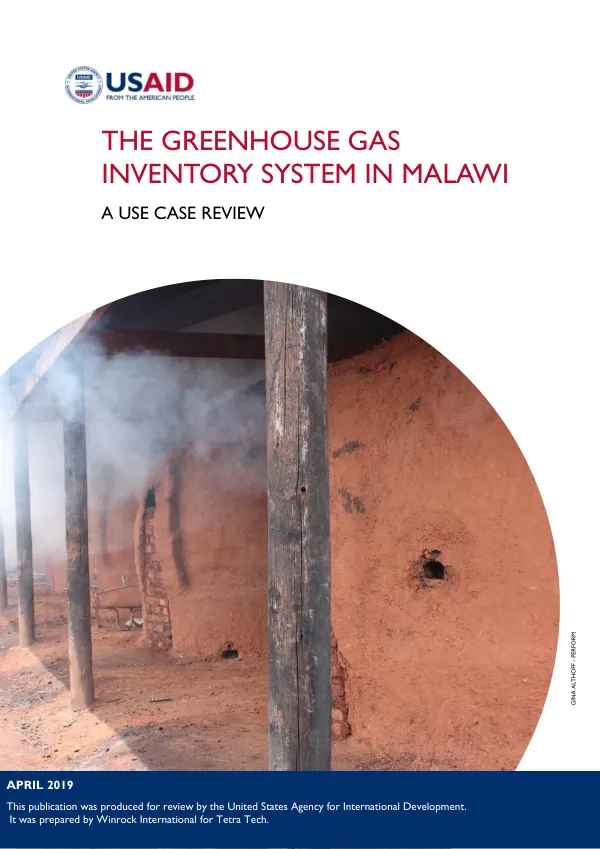
Greenhouse Gas Inventory System in Malawi: A Use Case Review
The Government of Malawi initiated a project to develop a national Greenhouse Gas Inventory System (GHG-IS) to improve institutional capacity, systems, and technical capacity in the Environmental Affairs Department (EAD) within the Ministry of Natural Resources, Energy and Mining.
2019 · 26 pages
Sign in to readA free account is required to download.
Abstract
The GHG-IS was developed with the support of USAID/Malawi to undertake the monitoring of GHG emissions at a national scale for all major sources and to produce a consistent foundation of knowledge to inform development of Low Emission Development Strategies (LEDS) policies and measures. Malawi has undertaken several national GHG accounting exercises, including the National Communications to the UNFCCC, but these efforts have not been conducted within a consistent monitoring framework. The GHG-IS provides clarity on methodological approach, data sources, and emission factors for all national-relevant emissions-producing activities, and it consists of Microsoft Excel-based calculation tools, standard operating procedures for data entry and quality control, institutional arrangements governing responsibilities for data provisioning, training materials on GHG accounting fundamentals, and templates for report generation for key anticipated reporting requirements. The Environmental Affairs Department is currently in the process of adopting the GHG-IS as the primary instrument for satisfying its obligation to report national emissions estimates to the UNFCCC through the National Communication and Biennial Update Report processes. The GHG-IS was designed primarily to support national-level monitoring and planning, but it can be readily adapted for other uses. The report identifies a range of potential beneficiaries of the GHG-IS, including the Government of Malawi as it plans to meet its emissions monitoring and emissions reduction-related commitments, such as the Third National Communication, Nationally Determined Contributions, Bonn Challenge/Africa Forest Landscape Restoration Initiative (AFR100), the Malawi REDD+ Program (MRP), and Nationally Appropriate Mitigation Actions. The report also identifies multilateral and bilateral donors, private sector, and other stakeholders who can benefit from the GHG-IS. The GHG-IS is a package of resources that can be applied to various planning and monitoring needs at different scales. It includes Microsoft Excel-based calculation tools, standard operating procedures for data entry and quality control, institutional arrangements governing responsibilities for data provisioning, training materials on GHG accounting fundamentals, and templates for report generation for key anticipated reporting requirements. The Government of Malawi has identified several key sectors that can benefit from the GHG-IS, including electricity generation, on-site energy use for all businesses, waste generation for all businesses, and agriculture. The report also highlights the importance of sectoral working groups, department of economic planning and development, national planning commission, public sector investment programming, and public-private partnership commission in implementing the GHG-IS. The report emphasizes the need for a consistent monitoring framework to interpret trends over time and to independently verify the results. The GHG-IS provides a consistent foundation of knowledge to inform development of LEDS policies and measures, and it can be readily adapted for other uses. The report concludes by highlighting the potential benefits of the GHG-IS for the Government of Malawi, multilateral and bilateral donors, private sector, and other stakeholders.
Related documents