USAID DEC
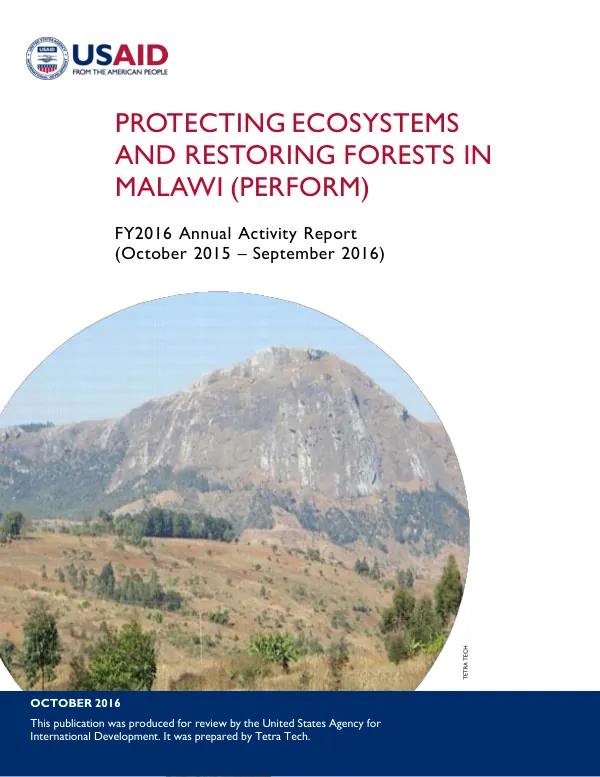
Protecting Ecosystems and Restoring Forests in Malawi (PERFORM) FY2016 Annual Activity Report
Sign inGOVERNMENT OF MALAWI
Protecting Ecosystems and Restoring Forests in Malawi (PERFORM) FY2016 Annual Activity Report
The Protecting Ecosystems and Restoring Forests in Malawi (PERFORM) project began its contractual period of performance on September 2, 2014, and will end on September 1, 2019.
2016 · 55 pages
Sign in to readA free account is required to download.
Abstract
The project's objectives are to advance Reducing Emissions from Deforestation and Degradation (REDD+) readiness, increase low-emissions land use opportunities, improve low-emissions development capacities, institute pathways for sustainability, and advance Country Development Cooperation Strategy (CDCS) priorities of integration and institutional strengthening. The project's premise is that achieving these objectives will help Malawian institutions and communities conserve forests and promote green growth, contributing to the United States Agency for International Development Malawi (USAID/Malawi) CDCS goal of improving Malawians' quality of life. Fiscal Year 2016 was a productive year for PERFORM, with the project meeting or exceeding 12 of 13 indicator targets. Significant achievements in FY2016 include the demonstration of increased capacity of key institutions for REDD+, with PERFORM increasing the REDD+ data collection, analysis, and utilization capacities of seven Malawian institutions. The project also responded adaptively to emerging Government of Malawi (GoM) priorities, such as the National Charcoal Strategy, while remaining focused on PERFORM results and targets. The project's progress and achievements in FY2016 are documented in the report, which highlights the project's ability to be a responsive and flexible partner to the GoM. The report also provides a summary of the project's performance against established targets, including the increase in capacity of key institutions for REDD+ and the project's response to emerging GoM priorities. The PERFORM project's work plan for FY2016 was approved by the USAID/Malawi, and the project implemented a range of activities to achieve its objectives. The project's performance monitoring and evaluation plan (PMEP) was also implemented, which included monitoring and evaluation of the project's progress against established targets. The project's personnel, including the Chief of Party, Deputy Chief of Party, and other staff, played a critical role in implementing the project's activities and achieving its objectives. The project also received support from various stakeholders, including the Government of Malawi, civil society organizations, and the private sector. The PERFORM project's achievements in FY2016 demonstrate the project's ability to make a positive impact on the environment and the lives of Malawians. The project's continued focus on achieving its objectives and contributing to the USAID/Malawi CDCS goal of improving Malawians' quality of life is expected to continue in the coming years. The project's work in advancing REDD+ readiness and increasing low-emissions land use opportunities has contributed to the reduction of greenhouse gas emissions and the conservation of forests in Malawi. The project's efforts to improve low-emissions development capacities and institute pathways for sustainability have also contributed to the development of a more sustainable and environmentally friendly economy in Malawi. The PERFORM project's achievements in FY2016 are a testament to the project's commitment to its objectives and its ability to adapt to changing circumstances. The project's continued success will depend on its ability to remain flexible and responsive to emerging priorities and challenges, while continuing to focus on achieving its objectives and contributing to the USAID/Malawi CDCS goal of improving Malawians' quality of life. The project's work in Malawi has also contributed to the development of a more sustainable and environmentally friendly economy in the country. The project's efforts to promote green growth and reduce greenhouse gas emissions have helped to reduce the country's dependence on fossil fuels and promote the use of renewable energy sources.