USAID DEC
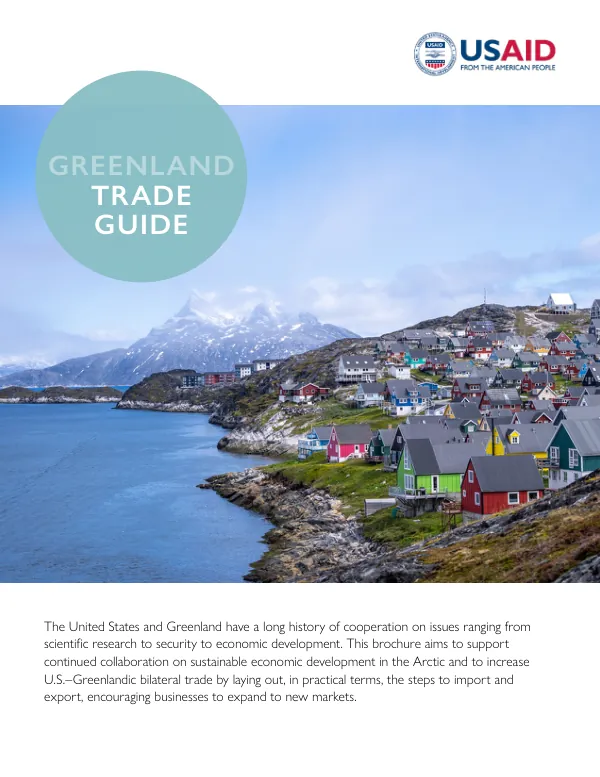
Greenland Trade Guide
The United States and Greenland have a long history of cooperation on various issues, including scientific research, security, and economic development.
2021 · 6 pages
Sign in to readA free account is required to download.
Abstract
The two nations have a strong foundation for continued collaboration on sustainable economic development in the Arctic. To increase U.S.–Greenlandic bilateral trade, the U.S. government offers numerous resources to encourage trade. The United States is the world's largest consumer market, with a household final consumption expenditure valued at $15.9 trillion in 2021. Breaking into this market may seem daunting, but the U.S. government provides guidance on the International Trade Administration and U.S. Customs and Border Protection (CBP) websites. First-time traders can find practical guidance and links to many resources on these websites. Greenlandic companies planning to sell goods in the U.S. market should familiarize themselves with the general requirements for goods to enter the U.S. market and specific requirements for their product or sector. All imports and exports must be reported through the Automated Commercial Environment (ACE) system, through which CBP determines admissibility. Food products must be safe, sanitary, and properly labeled, and the facilities that produce, store, or handle these products must be registered with the U.S. Food & Drug Administration (FDA). CBP does not require an importer to have a license or permit, but other agencies may require a permit, license, or other certification, depending on the commodity being imported. CBP forms require an importer number, which is the same as the Internal Revenue Service (IRS) business registration number. If the importer is not a registered business, they can use a Social Security number or request that CBP assign a number by completing DBP Form 5106 and submitting the form at the port of entry. To enter the United States, goods must be classified by a ten-digit Schedule B number. The first six digits are the internationally recognized Harmonized System (HS) code administered by the World Customs Organization. The last four digits of the ten-digit Schedule B number are unique to the United States. Traders can use the Schedule B Search Engine to find the correct number, and some goods can be difficult to classify, so traders may wish to work with a freight forwarder that can help to classify the product. The U.S. government offers various trade resources, including the U.S. Department of Commerce, International Trade Administration, U.S. Customs and Border Protection, U.S. International Trade Commission, and U.S. Census Bureau. The Harmonized System is an internationally recognized system for classifying traded products, developed and administered by the World Customs Organization. In the Harmonized System, products are categorized by chapters, headings, and subheadings, and they are assigned a six-digit code. The U.S. International Trade Commission has a Harmonized Tariff Schedule (HTS) search tool that traders can use to determine the duties applicable to their goods. The United States calculates import duties and taxes based only on the value of the goods or the Free on Board (FOB) price, which means that tax is paid only on the value of the imported good, not on the cost of shipping the goods. Once the importer has identified a supplier in Greenland, the buyer and seller must agree on terms of sale and shipping arrangements, including who will be responsible for freight or shipping costs, insurance, documentation, customs clearance, delivery, and other logistical activities. The bill of lading or air waybill serves as a receipt and is required for the importer to file an entry with CBP. An electronic cargo declaration must be transmitted to CBP 24 hours before the cargo is loaded on the vessel. When goods arrive at the port of entry, the importer receives a notice of arrival from the carrier with details for pickup. With this notice and the bill of lading, the importer can file import documents with CBP at the port of entry. These can include CBP Form 3461, CBP Form 7501, the commercial invoice, the bill of lading or airwaybill, the packing list, and a Customs Bond. Within 15 days of arrival, an electronic filing must be completed on the ACE system. The CBP website includes a number of useful resources, including a brief video that introduces importers to the CBP import process. For support in completing this documentation, the importer may wish to hire a licensed customs broker. Shipments valued under $2,500 can enter via informal entry, a simplified procedure for low-value shipments. Greenland is a niche market that offers an opportunity for U.S. businesses to expand their reach to new customers who are seeking more diverse product offerings. Geographically isolated, with a population of approximately 57,000, Greenland currently lacks the product diversity found in other North American markets. The U.S. government provides resources to encourage trade with Greenland, including the International Trade Administration and U.S. Customs and Border Protection websites. A producer in Greenland plans to export frozen coldwater shrimp to the United States, where she has located a buyer. She uses the U.S. Census Bureau Schedule B Search