USAID DEC
Improving Customs and Trade Facilitation in the Context of Domestic Resource Mobilization
Sign inDEVTECH SYSTEMS, INC.
Improving Customs and Trade Facilitation in the Context of Domestic Resource Mobilization
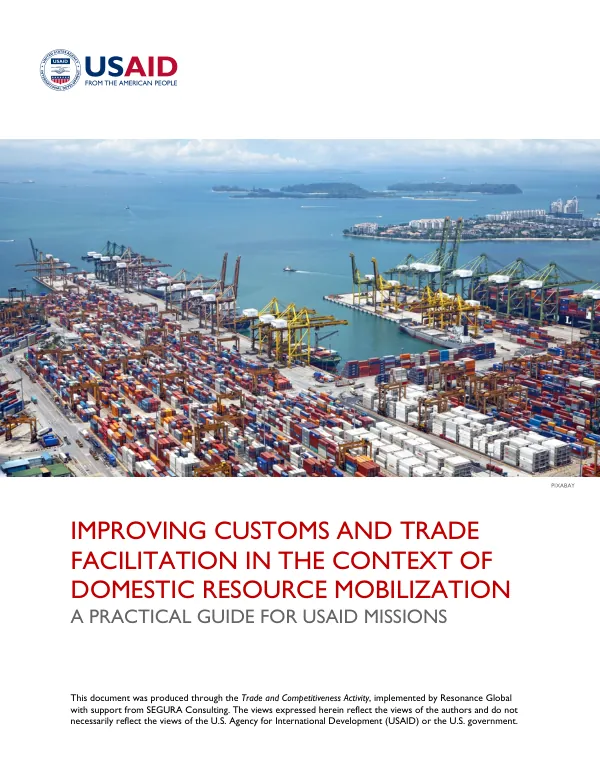
The Trade and Competitiveness Activity, implemented by Resonance Global with support from SEGURA Consulting, produced a document titled "Improving Customs and Trade Facilitation in the Context of Domestic Resource Mobilization: A Practical Guide for USAID Missions."
2021 · 52 pages
Sign in to readA free account is required to download.
Abstract
The guide aims to provide USAID Mission staff with an understanding of the role of customs and trade facilitation in strengthening domestic resource mobilization (DRM) and practical tips for project design and implementation in these areas. The guide is organized into several main sections, including definitions, technical background and context, key stakeholders, activity design and implementation, suite of potential interventions, best practices and lessons learned, and annexes. The definitions section highlights key terms used throughout the document, such as advance rulings, authorized economic operators, customs authorities, customs reform, customs revenue, domestic resource mobilization, and domestic tax revenue. Customs reform and modernization refer to the organized efforts of customs authorities and related agencies to simplify, standardize, harmonize, and optimize customs procedures. Examples of customs reform and modernization include streamlining or digitizing customs paperwork, electronic platforms for customs declaration and clearance, risk management tools for customs inspections, and formal coordination procedures between border management agencies. Domestic resource mobilization is the process through which countries raise and spend their own funds to sustain their operations and support their citizens through delivery of public services. It is an important means of sustainable country-led development to reduce long-term reliance on foreign aid. The guide emphasizes the importance of customs and trade facilitation in strengthening DRM and provides practical tips for project design and implementation in these areas. It also highlights the role of key stakeholders, including customs authorities, private sector participants, and national trade facilitation committees, in promoting customs and trade reforms. The guide is intended for USAID Mission staff with limited or no experience in designing and/or managing programming aimed at promoting customs and trade reforms. It is also relevant for other USAID staff, implementing partners working in these technical areas, and cooperating country stakeholders who both influence and are affected by these reforms. The guide provides a base-level grounding in important concepts, principles, and interventions and enables Mission personnel to better engage with country counterparts to set and promote realistic, sustainable goals for revenue mobilization through trade and customs. It also highlights advice and insights gained from interviews with Mission personnel and other colleagues, with a focus on the sustainability of interventions. The guide is organized in a logical and easy-to-follow manner, with clear headings and subheadings that facilitate navigation and understanding of the content. The use of definitions and explanations of key terms helps to clarify complex concepts and ensure that readers have a common understanding of the terminology used throughout the guide. The guide is a valuable resource for USAID Mission staff and other stakeholders working in the areas of customs and trade facilitation. It provides a comprehensive overview of the role of customs and trade facilitation in strengthening DRM and offers practical tips and guidance for project design and implementation in these areas.