ACDI/VOCA
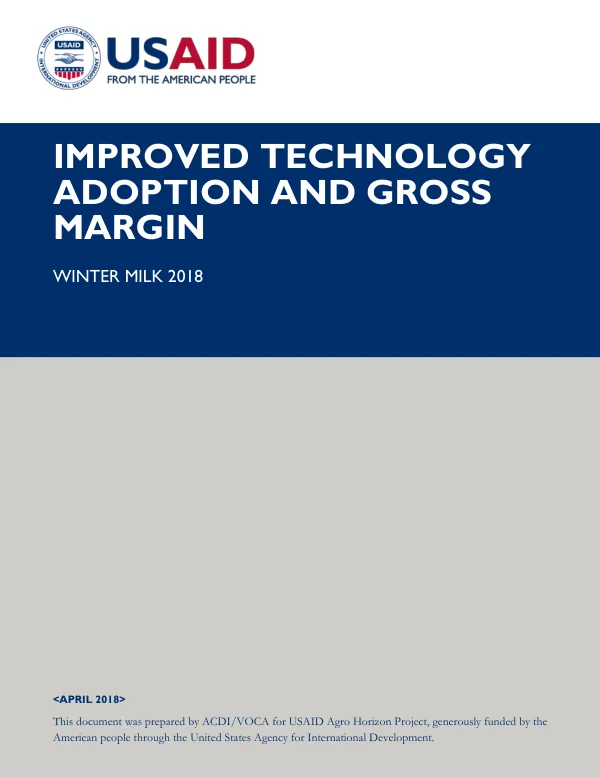
Gross Margin-Winter Milk 2018
The Agro-Horizon project, facilitated by USAID, aimed to improve milk production among farmers in the winter season.
2018 · 8 pages
Sign in to readA free account is required to download.
Abstract
In year 4 of the project, 222 milk producers received training in animal husbandry, with a focus on improving milk yield among farmers linked to three processors in Osh. At least 60% of the daily milk requirement was met during the winter season, indicating further opportunities for farmers to increase household incomes. The purpose of the measurement was to document farmers' adoption of recommended animal management practices, value of incremental sales at farm level, and gross margin arising from investing in producing milk during the 2017/2018 winter season. The findings were compared with gross margin baseline values and previous results from the 2016/2017 winter season. Simple random sampling was employed to select 150 farmers for the measurement, representing 68% of the total number of farmers and drawn from 10 out of 30 villages. The results showed that 98.6% and 98.3% of farmers used veterinary services in the 2016/2017 and 2017/2018 winter seasons, respectively. Additionally, 90% of the sampled farmers used local cow breeds to produce milk in both seasons. According to expert opinion, cows produce most milk at the age of 6-8 years, after 3 births, and the majority of farmers used animals of appropriate age to optimize milk production in both seasons. All farmers used at least one improved technology to boost milk production during the winter, including recommended age of animals for milk production, veterinary services, insemination, and warming milking barns and targeted feeding for milk production. The project registered a value of 95,475 USD in incremental sales at farm level among farmers that engaged in milk production in the winter. The corresponding gross margin value showed a 22% increase from the baseline during the 2017/2018 season. The average milk production prior to project intervention was 4 liters per day per animal, and 8 liters per day during the recent survey with project intervention. However, although milk production doubled, the average price per liter in 2016 was 23KGS, and in 2017/2018 season, the average price was 21KGS. The results indicate that the project has been successful in improving milk production and increasing household incomes among farmers in the winter season.