INTERNATIONAL FINANCE CORPORATION
Post-Event Brief: Eleventh Central Asia Trade Forum
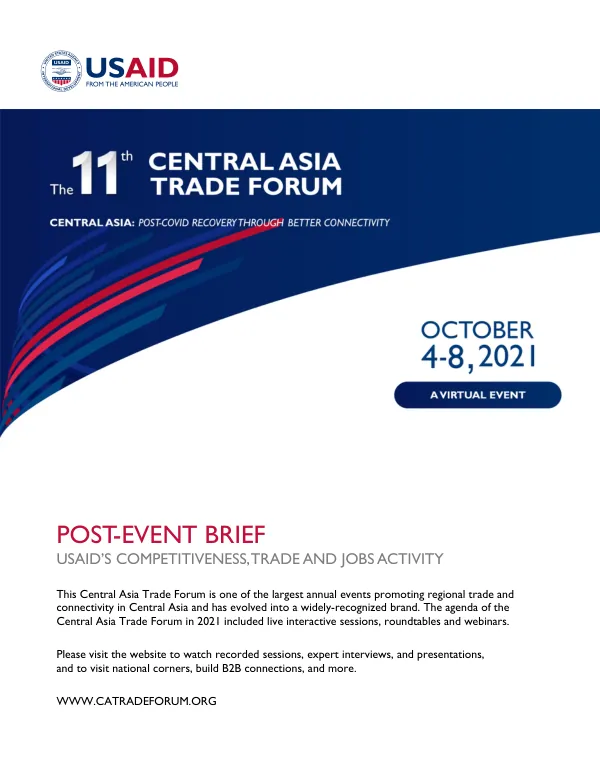
The eleventh annual Central Asia Trade Forum, organized by USAID's Competitiveness, Trade and Jobs activity (CTJ), took place from October 4-8, 2021.
2021 · 11 pages
Sign in to readA free account is required to download.
Abstract
The event, entitled "Post-COVID Recovery Through Better Connectivity," promoted regional trade and connectivity and highlighted innovations and policies for accelerating economic recovery across Central Asia. The Forum's 10 panels focused on the still challenging COVID-19 environment, where the need for trade facilitation has never been more important due to the many restrictions imposed to halt the virus's spread. This dictated new approaches to multi-stakeholder collaboration, with the move to a virtual format enabling the CATF to reach a greater number of partners, participants, and speakers than in any of its previous years. The Forum coincided with 30 years of cooperation between the United States and the five Central Asian republics. Over that period, the United States has provided over $9 billion in direct assistance to support peace and security, democratic reform, economic growth, and humanitarian needs. Through bilateral relationships and regional strategies for cooperation and collaboration, these efforts have enabled the region's economies to become more competitive, more diversified, and faster growing. The event's five-day program featured 10 panel discussions, two roundtables, over 100 inspiring speakers, and 6,000 unique visitors from 47 countries, including the United States, Afghanistan, Switzerland, United Kingdom, Australia, Japan, Turkey, and Pakistan, among others. Participants connected to online live sessions to discuss trends in trade, business support ecosystems, reviving tourism in the wake of COVID-19, regional trade and transit, water sustainability, energy investments, trans-Asia connectivity, and greater economic participation for women and youth. The virtual portions of the event were delivered via multiple online platforms, including Zoom, Microsoft Teams, and YouTube, to bring together global and local experts, innovators, and businesspeople to forge connections. Management certification company, CERT Academy, provided management training on "ISO Standards and Practices for Sustainable Business Development" to small businesses across Central Asia. The Forum's opening speakers included Deputy Chief of Mission of the U.S. Embassy in Kazakhstan Judy Kuo, Cluster Coordinator of the GIZ regional programs in Central Asia Torsten Brezina, and Chairman of the Center for Trade Policy Development "QazTrade" Azamat Askaruly. They emphasized the importance of continuing regional dialogue despite the challenges posed by the pandemic and the need for nations to turn inward. The Forum organized a dedicated panel session on Reviving Tourism Amid COVID-19, which considered regional factors and policies that enable sustainable tourism development, contributing to the development and competitiveness of the Central Asian region. By better understanding the factors that affect tourism, public-private cooperation can be designed to enhance the competitiveness of small and medium businesses in tourism and related sectors. The United States is the primary sponsor of the Forum through the U.S. Agency for International Development's (USAID) Competitiveness, Trade, and Jobs activity in partnership with the German Society for International Cooperation (GIZ), CERT Academy, the Chartered Institute of Logistics and Transport, Global Cold Chain Alliance, International Road Transport Union (IRU), International Finance Corporation (IFC), International Trade Centre (ITC), Kazakhstan Federation of Organic Agriculture Movement (KAZFOAM), Women in Logistics and Transport, the World Travel Market, World Bank, Next Generation Central Asia, and other USAID-funded projects. Twelve virtual gatherings were hosted in collaboration with ITC, QazTrade, KazakhTorusim, UN FAO, CILT, KazATO, GIZ, WiLAT, CERT Academy, and other USAID-funded projects, aimed at fast-tracking actions for more trade by convening more than 6,000 online participants across multiple platforms. Other USAID activities, including USAID's Future Growth Initiative, USAID Power Central Asia, and USAID's Water and Vulnerable Environment activity, led a number of sectorial panel sessions. The Forum enabled leaders of governments and private sector to create new visions and new partnerships in CTJ's interconnected focus areas: transport & logistics, horticulture, and tourism. Stakeholder collaboration deepened the understanding of complex issues, shaped new models and standards, and inspired cooperation. The Forum included 10 panel sessions, two roundtables, and over 100 inspiring speakers who are leading experts in their field. Within the Central Asia Trade Forum, a virtual display entitled "The National Corner of Central Asia" showcased the tourism opportunities in each of the region's countries. Participants were invited to join USAID and WideOyster on a trip through the region in the "Central Asia: The Last Frontier" special issue. The issue featured descriptive storytelling on each of the five Central Asian states and the unique aspects of each country's travel sector.