USAID DEC
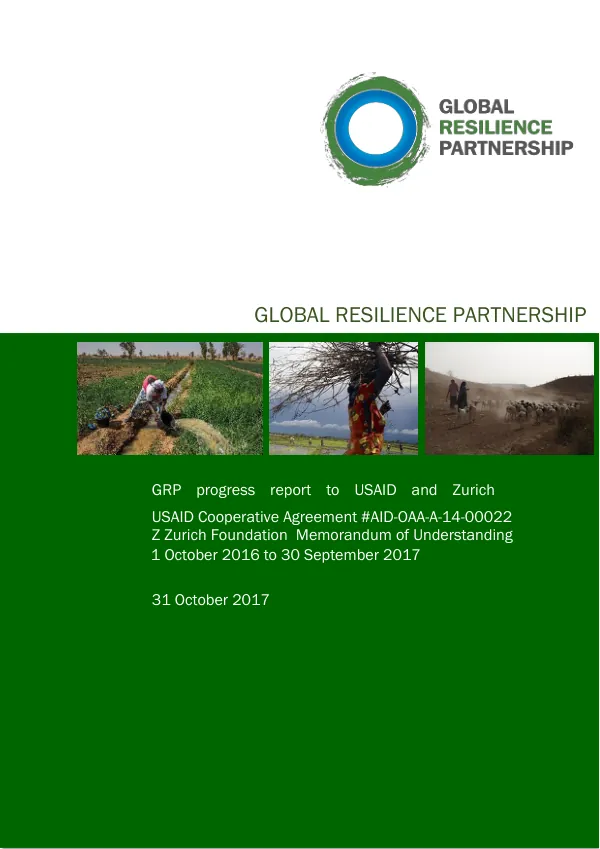
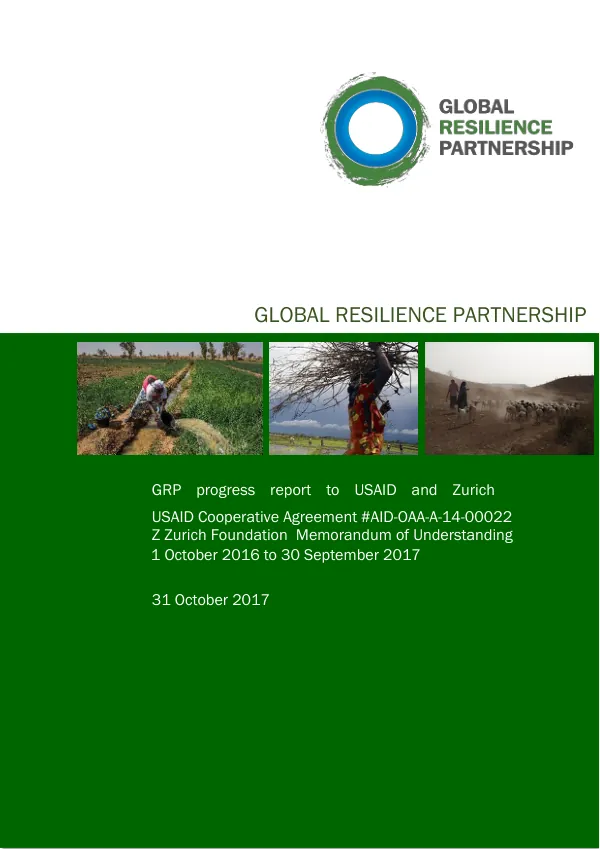
GRP Progress Report to USAID and Zurich for the Period 1 October 2016 to 30 September 2017
Sign inBRAC INTERNATIONAL
GRP Progress Report to USAID and Zurich for the Period 1 October 2016 to 30 September 2017
The Global Resilience Partnership (GRP) is a collaborative effort between various organizations, including the U.S.
2017 · 37 pages
Sign in to readA free account is required to download.
Abstract
Agency for International Development (USAID) and the Zurich Foundation. The partnership aims to support resilience in vulnerable communities worldwide. For the period from 1 October 2016 to 30 September 2017, GRP focused on supporting R1 grantees with contract addendums, preparing for the closure of seven R1 grantees by the end of 2017, and assisting Water Window (WW) grantees with budget and project amendments. GRP's core support budget was not confirmed since September 2016, severely curtailing many GRP activities outside of the Challenges and Challenge support. The partnership navigated the decision of the Rockefeller Foundation to withdraw from the Partnership, which further impacted budgets and staffing. As a result, various activities and plans were paused or canceled. Key staff members, including the GRP M&E director and GRP M&E Manager, left the organization in January 2017. The GRP Executive Director and GRP Communications Directors departed in August 2017. Despite these challenges, the GRP Partnership Council Meeting held on 7th and 8th September marked an important milestone in GRP's evolution. Partners confirmed a clear interest in the relevance and utility of resilience in addressing protracted aid and development issues. The consensus from partners was that GRP can have an important leadership role in the resilience space, informing and galvanizing action on resilience. Partners shared that while some milestones have been clearly met, the full potential of GRP has not yet been realized. The GRP Partnership Council Meeting also led to a decision to host GRP at the Stockholm Resilience Centre, with KPMG shifting from host to existing challenge manager. The Technology and Infrastructure programmatic feature has been working closely with scaling grantees, including MetaMeta, to prepare the Incubation Hub to provide bespoke scaling advice and support to both Zurich and USAID grantees. The Policy and Influence programmatic feature delivered a workshop with IIED on local level resilience and is engaged in conversations with key private sector actors on resilient bonds and funds. The Markets and Innovative Finance programmatic feature postponed further work until new budgets are confirmed in 2018. GRP has also been active at a number of key events, including Resilience 2017 in Stockholm, where three grantees from Zurich, BRAC, MetaMeta, and Potsdam were sponsored to present. The partnership has been working closely with its partners to facilitate a smooth transition and is planning new staffing for the Secretariat from early 2018. A budget proposal has been submitted to SIDA by SRC and the Secretariat for core funding from 2018 onwards, which is currently under review. The GRP has been supporting R1 grantees, with a focus on contract addendums, budget and project amendments, and Monitoring, Evaluation, and Learning (MEL) guidance. The partnership has also been working with Water Window grantees, providing MEL support and guidance. The GRP has been active in various programmatic features, including Technology and Infrastructure, Policy and Influence, and Markets and Innovative Finance. The partnership has been engaging with key stakeholders, including private sector actors, to promote resilience and support vulnerable communities. GRP's progress has been monitored and evaluated through various reports and assessments. The partnership has been working closely with its partners to ensure a smooth transition and to plan for future activities. The GRP has been active in various events and workshops, including Resilience 2017 in Stockholm, to promote resilience and support vulnerable communities. The partnership has been working closely with its partners to facilitate a smooth transition and is planning new staffing for the Secretariat from early 2018.
Related documents