USAID DEC
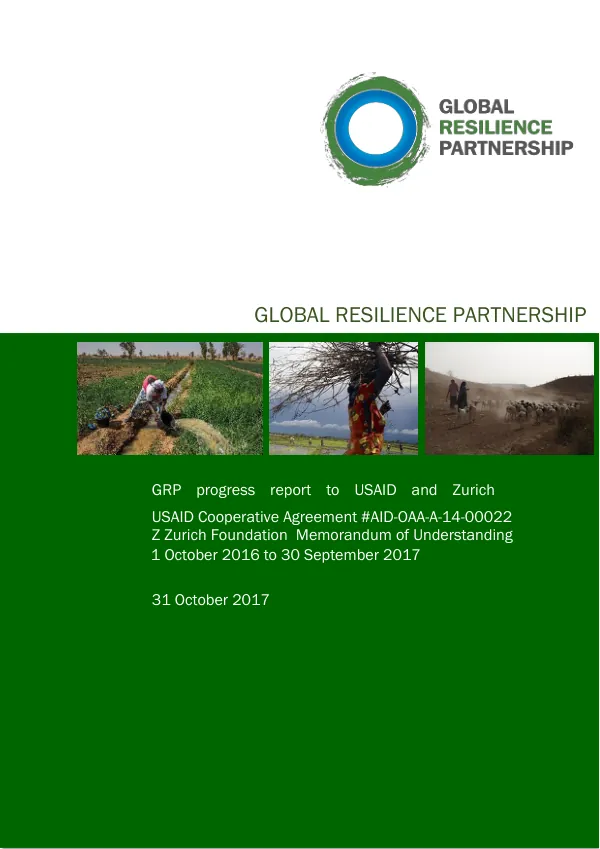
GRP Progress Report to USAID and Zurich for the Period 1 October 2016 to 30 September 2017
Sign inKPMG
GRP Progress Report to USAID and Zurich for the Period 1 October 2016 to 30 September 2017
The Global Resilience Partnership (GRP) has been focused on supporting R1 grantees with contract addendums, preparations for closing out seven of the ten R1 grantees by the end of 2017, and assisting Water Window (WW) grantees with budget and project amendments.
2017 · 39 pages
Sign in to readA free account is required to download.
Abstract
GRP also provided Monitoring, Evaluation, and Learning (MEL) guidance to WW and R1 grantees. The partnership did not have access to a confirmed core support budget since September 2016, which severely curtailed many GRP activities outside of the Challenges and Challenge support. A significant focus in the first half of the year was on navigating the decision of the Rockefeller Foundation (RF) to withdraw from the Partnership. This decision further impacted budgets and staffing, resulting in the pause or cancellation of various activities and plans. GRP M&E director Laura Mattioli and GRP M&E Manager Harleen Thati left GRP at the end of January 2017. The GRP Executive Director and GRP Communications Directors both left in August 2017. Twebese Mugisha was appointed the new Communications Director, and the former GRP Communications Director, Stephanie Speck, joined the Stockholm Resilience Centre (SRC) as an Advisor to GRP on a part-time basis. GRP added two new staff members, a DFID seconded, full-time Senior Policy Adviser to the GRP core team in January for an initial period of two years with a further one-year extension option, and a Program Director who started in February. The GRP Partnership Council Meeting held on the 7th and 8th September marked an important milestone in GRP's evolution. During the PC meeting, partners confirmed a clear interest in the relevance and utility of resilience in addressing protracted aid and development issues. The consensus from partners was that GRP can have an important leadership role in the resilience space, informing and galvanizing action on resilience. The GRP Partnership Council Meeting also confirmed its wish that GRP would, with immediate effect, be hosted by the Stockholm Resilience Centre, which KPMG fully supports. KPMG's role has shifted from host to existing challenge manager. There is no change to the challenges or grantee communication and management, although all grantees have been updated on the outcome of the PC Meeting. KPMG is working closely with SRC to facilitate a smooth transition for GRP, which will continue until KPMG's current management of the challenges finishes late in 2018. New staffing is planned for the Secretariat from early 2018. The Technology and Infrastructure programmatic feature has been working closely with scaling grantees, including MetaMeta, and preparing the Incubation Hub to provide bespoke scaling advice and support to both Zurich and USAID grantees that are now proceeding. The Policy and Influence programmatic feature delivered a workshop with IIED on local level resilience and is engaged in conversations with key private sector actors on resilient bonds and funds. The feature is currently developing a plan for taking policy lessons from community resilience efforts into policy at a national level through a series of engagement workshops that will involve both USAID and Zurich grantees. As part of the Markets and Innovative Finance programmatic feature, Stephanie Speck was invited by The Bill & Melinda Gates Foundation, the United Kingdom Department for International Development (DFID), the German Federal Ministry for Economic Cooperation and Development (BMZ), and the United States Agency for International Development (USAID) to participate in the Digital Financial Services in Humanitarian Contexts: An Action Agenda to Enable Digital Payments for Better Response workshop on June 7-8 2017 in London. Further work in this feature has been postponed until new budgets are confirmed in 2018. GRP has also been active at a number of key events over the past year, including Resilience 2017 in Stockholm from 20th – 23rd April 2017.