DEMOCRACY INTERNATIONAL, INC.
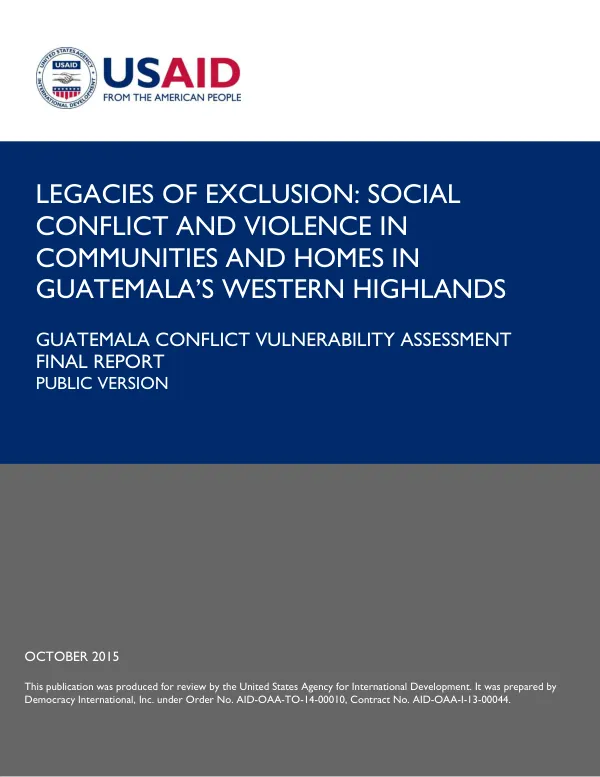
Guatemala Conflict Vulnerability Assessment – Final Report
The Western Highlands of Guatemala have been plagued by social conflict and violence, particularly in the departments of Quiché, Totonicapán, San Marcos, Huehuetenango, Quetzaltenango, and Sololá.
2015 · 74 pages
Sign in to readA free account is required to download.
Abstract
This region has a complex history of structural societal patterns that create conditions for conflict and violence. The legacy of exclusion, social inequality, and historical injustices has contributed to the persistence of violence in family and community settings. The assessment highlights the role of local governance conflicts, including adult fears, youth rebellion, gangs, and "security" responses, in perpetuating violence. The "legal state" and the "real state" are also identified as sources of conflict, as the state and para-state governance structures often clash. The report also examines the impact of licit and illicit employment options on social conflict, as well as the role of extractive industries, natural resources, and climate change in exacerbating tensions. The assessment identifies several key factors that contribute to social conflict and violence in the Western Highlands. These include the lack of access to land, the presence of gangs and other armed groups, and the limited availability of economic opportunities. The report also highlights the importance of addressing the root causes of conflict, including poverty, inequality, and social exclusion. The assessment was conducted using a Conflict Assessment Framework (CAF), which involves a comprehensive analysis of the social, economic, and political factors that contribute to conflict. The CAF was used to identify the key drivers of conflict in the Western Highlands and to develop recommendations for addressing these drivers. The report provides a detailed analysis of the social indicators in the Western Highlands, including poverty rates, education levels, and access to healthcare. The report also examines the role of indigenous law and the impact of climate change on social conflict. The assessment identifies several key recommendations for addressing social conflict and violence in the Western Highlands. These include: * Strengthening the capacity of local governance structures to address conflict and violence * Improving access to land and economic opportunities for marginalized communities * Addressing the root causes of conflict, including poverty, inequality, and social exclusion * Supporting the development of indigenous law and the rights of indigenous peoples * Addressing the impact of climate change on social conflict The report concludes that addressing social conflict and violence in the Western Highlands will require a comprehensive and sustained effort. This will involve working with local communities, civil society organizations, and government agencies to develop and implement effective strategies for addressing the root causes of conflict. The assessment was conducted by a team of researchers and logisticians from Democracy International, Inc., with support from the USAID Mission in Guatemala and the USAID Office of Conflict Management and Mitigation (CMM). The report provides a detailed analysis of the social conflict and violence in the Western Highlands and identifies key recommendations for addressing these issues. The report highlights the importance of addressing the root causes of conflict, including poverty, inequality, and social exclusion. It also emphasizes the need for a comprehensive and sustained effort to address social conflict and violence in the Western Highlands. The report provides a valuable resource for policymakers, practitioners, and researchers working to address social conflict and violence in this region. The assessment was conducted using a range of methodologies, including surveys, interviews, and focus groups. The report provides a detailed analysis of the data collected and identifies key trends and patterns in the social conflict and violence in the Western Highlands. The report concludes by emphasizing the need for continued support for the development of indigenous law and the rights of indigenous peoples. It also highlights the importance of addressing the impact of climate change on social conflict and the need for a comprehensive and sustained effort to address social conflict and violence in the Western Highlands.
Related documents