AVENIR HEALTH
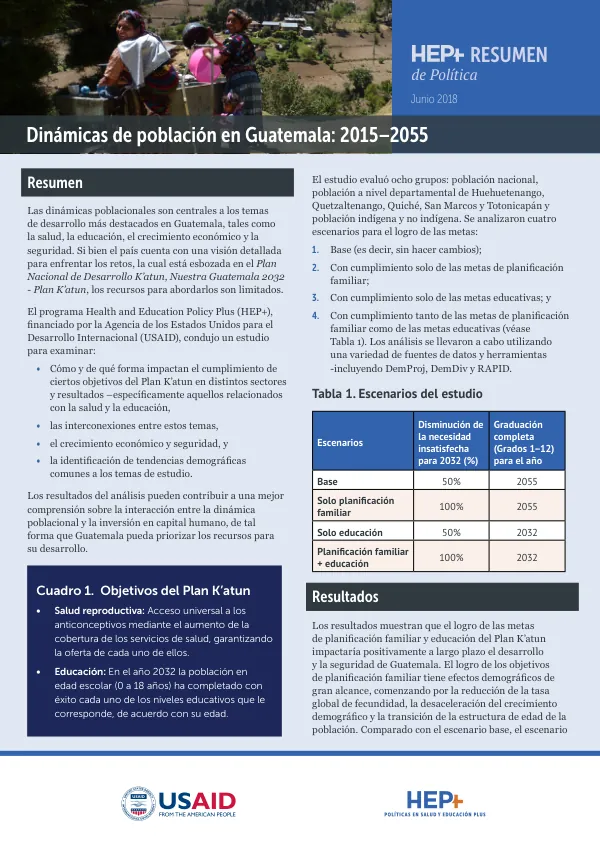
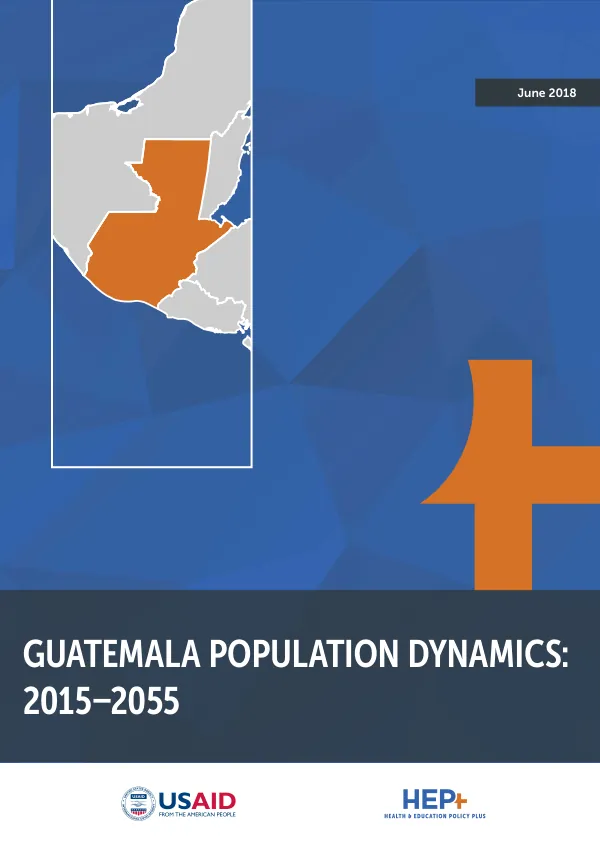
Guatemala Population Dynamics 2015-2055
Guatemala's population is projected to experience significant changes between 2015 and 2055.
2018 · 47 pages
Sign in to readA free account is required to download.
Abstract
The country's population has been growing steadily, with a doubling time of approximately 35 years between 1950 and 2015. As of 2015, the population pyramid shows a relatively young population, with a high proportion of individuals under the age of 25. Education is a critical factor in Guatemala's population dynamics. The gross enrollment ratio for primary and secondary school has improved over the past decade, with a slight increase in enrollment for girls. However, the net enrollment ratio remains lower, indicating that some children are not attending school. The age of students in primary grade has also increased, suggesting that more children are staying in school longer. Guatemala's total fertility rate (TFR) has been declining over the past few decades, from 6.4 children per woman in 1987 to 2.3 children per woman in 2014. The contraceptive prevalence rate has also increased, from 10% in 1987 to 53% in 2015. However, the unmet need for family planning remains high, with 24% of women of reproductive age indicating a desire to space or limit their births but not using any form of contraception. The demographic dividend, which refers to the economic benefits that can be realized when a country's population transitions from a high-fertility, high-dependency phase to a lower-fertility, lower-dependency phase, is a key concept in understanding Guatemala's population dynamics. The demographic dividend can lead to increased economic growth, improved education and health outcomes, and reduced poverty. However, Guatemala's population is projected to experience a significant increase in the proportion of dependents, from 63% in 2015 to 73% in 2055, which could hinder the realization of the demographic dividend. The report presents several scenarios that project the potential outcomes of different demographic and economic trends in Guatemala. The scenarios are based on different assumptions about fertility rates, education levels, and economic growth. The results show that the demographic dividend can be realized if fertility rates continue to decline and education levels improve. However, if fertility rates remain high and education levels do not improve, the demographic dividend may not be realized, and Guatemala's population may experience significant economic and social challenges. The report also examines the link between demography and violence in Guatemala. The country has experienced high levels of interpersonal violence, including homicides and domestic violence. The report suggests that the demographic dividend can help reduce violence by improving education and economic opportunities for young people. However, the report also notes that the relationship between demography and violence is complex and influenced by a range of factors, including poverty, inequality, and social norms. In conclusion, Guatemala's population is projected to experience significant changes between 2015 and 2055. The demographic dividend can be realized if fertility rates continue to decline and education levels improve. However, if fertility rates remain high and education levels do not improve, the demographic dividend may not be realized, and Guatemala's population may experience significant economic and social challenges. The report highlights the importance of addressing the root causes of violence and promoting education and economic opportunities for young people to reduce violence and improve overall well-being.
Related documents