ACTION CONTRE LA FAIM
Guatemala SMART Survey final report 2015
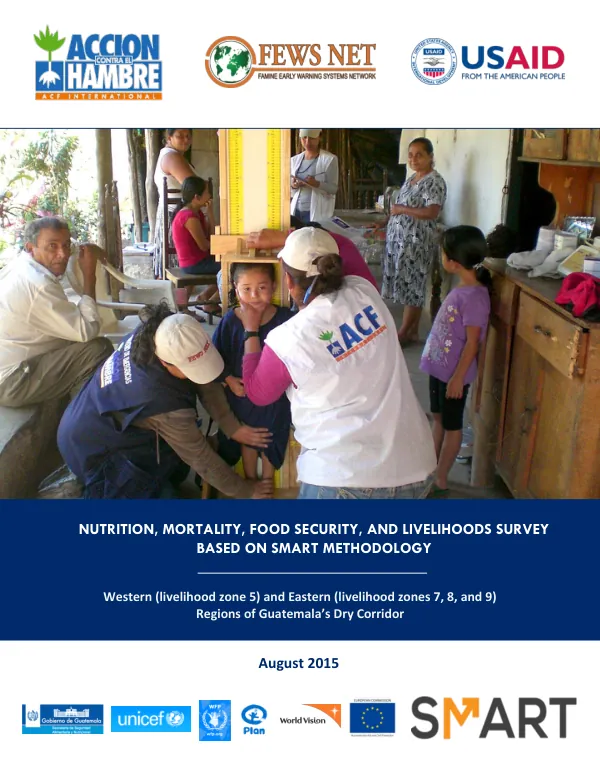
The Guatemala SMART Survey was conducted in August 2015 in the Western (livelihood zone 5) and Eastern (livelihood zones 7, 8, and 9) Regions of Guatemala's Dry Corridor.
2015 · 58 pages
Sign in to readA free account is required to download.
Abstract
The survey aimed to assess nutrition, mortality, food security, and livelihoods in the affected areas. The survey was based on the SMART methodology, which is a standardized monitoring and assessment tool for relief and transitions. The survey was an initiative of the USAID-funded Famine Early Warning System Network (FEWS NET) and was implemented by Action Contre la Faim-Central American mission (ACF). Other organizations, including the Secretariat for Food and Nutrition Security, UNICEF, the World Food Programme, Plan International, and World Vision, participated in the technical committee that provided support for the design, implementation, and closure of the survey. The survey used a multi-stage cluster sampling approach to select households and communities for data collection. The sampling frame consisted of 15 communities in the Western and Eastern Regions, which were selected based on their vulnerability to food insecurity and malnutrition. A total of 1,200 households were selected for data collection, with a response rate of 95%. The survey collected data on various indicators, including nutrition, mortality, infant and young children feeding, food security, and livelihoods. The nutrition module assessed the prevalence of acute malnutrition, stunting, and wasting among children under the age of 5. The mortality module collected data on the crude death rate and under-five death rate. The infant and young children feeding module assessed the feeding practices and nutritional status of infants and young children. The food security and livelihood module collected data on the coping strategies, food access, and livelihoods of households. The survey results showed that the prevalence of acute malnutrition was high in the affected areas, with 12.6% of children under the age of 5 suffering from severe acute malnutrition. The crude death rate was 7.4 per 1,000 population, and the under-five death rate was 54.6 per 1,000 live births. The survey also found that 45.6% of households reported using coping strategies to access food, and 21.1% of households reported having difficulty accessing food. The survey results were discussed in the context of the post-shock situation in the affected areas. The survey found that the post-shock situation was characterized by a decline in food access and an increase in food insecurity. The survey recommended that emergency food assistance be provided to affected households, and that long-term interventions be implemented to improve food security and livelihoods in the affected areas. The survey also highlighted the importance of addressing the underlying causes of food insecurity and malnutrition in the affected areas. The survey recommended that the government and other stakeholders implement policies and programs to improve agricultural productivity, access to markets, and social protection for vulnerable households. The survey results were presented in a series of tables, figures, and boxes, which provided a detailed analysis of the data collected. The survey also included an abstract, which provided a summary of the main findings and recommendations. The survey was prepared under the USAID-funded Famine Early Warning Systems Network (FEWS NET) Indefinite Quantity Contract, and the views expressed in the publication do not necessarily reflect the views of the United States Agency for International Development or the United States Government.
Related documents