CARE
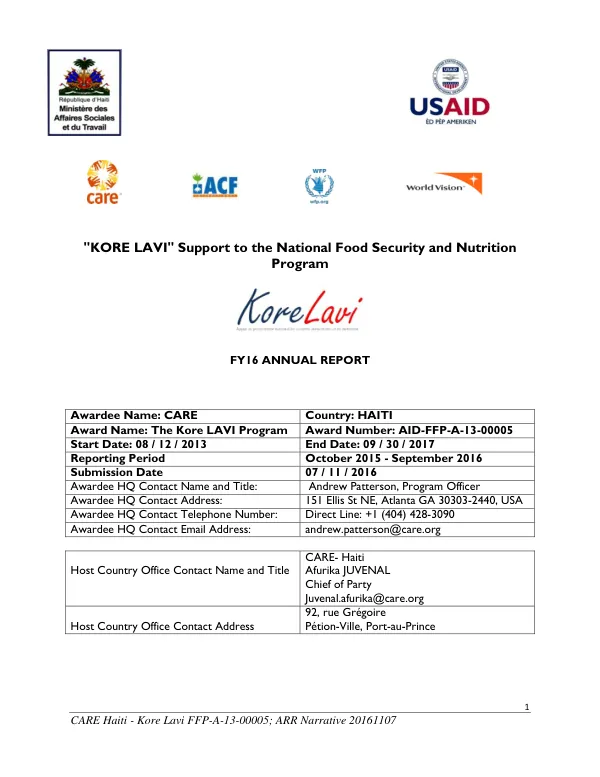
KORE LAVI Support to National Food Security and Nutrition Program
The Kore Lavi Program in Haiti is a food security and nutrition initiative implemented by CARE, a consortium partner of the Food for Peace (FFP) program.
2016 · 59 pages
Sign in to readA free account is required to download.
Abstract
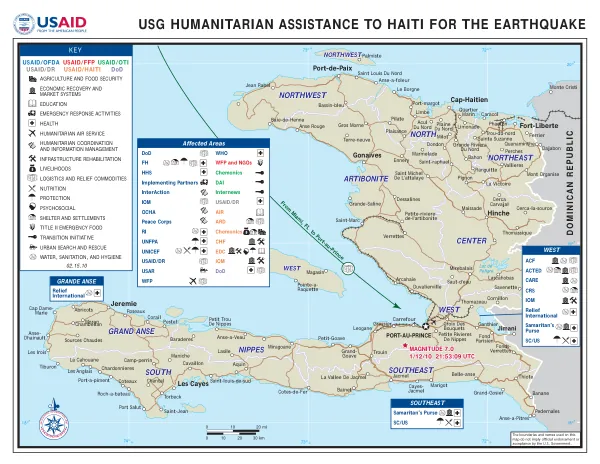
The program's geographic focus is on 24 communes in the Upper Artibonite and North departments of Haiti. The program's start date is August 12, 2013, and the end date is September 30, 2017. The program's main objective is to improve food security and nutrition outcomes for vulnerable populations, particularly women and children. The program's strategic objectives are aligned with the Haitian government's priorities, focusing on vulnerability targeting, food voucher-based safety nets, maternal and child health and nutrition, and stewardship. The program's implementation is led by a Chief of Party, Afurika Juvénal, and is supported by a team of technical coordinators, including a Food Safety Net Technical Coordinator and a Maternal and Child Health and Nutrition Technical Coordinator. The program's monitoring and evaluation system is designed to track progress against key indicators, including food security, nutrition, and health outcomes. The program's activities are implemented through a network of community-based organizations, including community-based organizations (CBOs) and village savings and loans associations (VSLAs). The program also works closely with the Haitian government, including the Ministry of Agriculture, Natural Resources and Rural Development (MARNDR) and the Ministry of Public Health and Population (MSPP). The program's commodity distribution is managed through a system of vouchers, which are redeemed at local markets for food and other essential items. The program also provides support for agricultural production, including training and inputs for farmers. The program's results are reported in the Annual Results Report (ARR), which provides an overview of the program's performance against key indicators. The ARR reports a 27% increase in household income among program participants compared to the control group, as well as improvements in food security and nutrition outcomes. The program's lessons learned and key successes are documented in Annex 1 of the ARR, which highlights the importance of community-based approaches, partnerships with local organizations, and the use of vouchers to support food security and nutrition outcomes. The program's implementation challenges and responses are also documented in Annex 2, which highlights the importance of adapting to changing circumstances and building the capacity of local partners. Overall, the Kore Lavi Program in Haiti is a comprehensive initiative that aims to improve food security and nutrition outcomes for vulnerable populations. The program's results demonstrate the effectiveness of community-based approaches and the importance of partnerships with local organizations in achieving sustainable development outcomes.
Related documents