USAID DEC
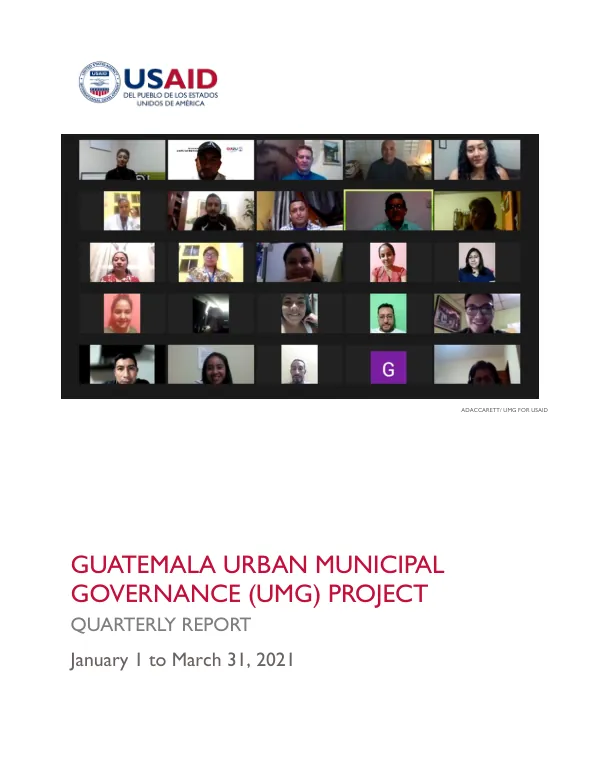
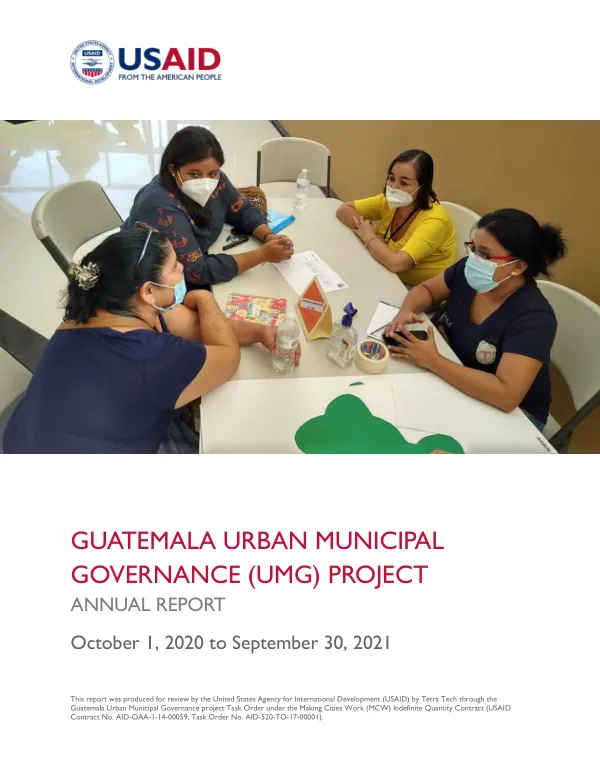
Guatemala Urban Municipal Governance (UMG) Project Annual Report October 1, 2020 to September 30, 2021
Sign inTETRA TECH
Guatemala Urban Municipal Governance (UMG) Project Annual Report October 1, 2020 to September 30, 2021
The Urban Municipal Governance project in Guatemala was designed to reduce levels of violence in municipalities most at risk of violent crime through enhanced municipal governance, increased coverage and quality of municipal services, and greater citizen participation and oversight.
2021 · 40 pages
Sign in to readA free account is required to download.
Abstract
The project was awarded to Tetra Tech by the United States Agency for International Development (USAID) in January 2017 and was scheduled to run for five years. The project's primary objectives were to strengthen municipal performance, improve service delivery, and enhance citizen engagement. To achieve these objectives, the project provided technical assistance, capacity building support, and resources for direct improvements to community-based organizations working in partnership with municipalities to improve services that help reduce crime and violence. In the fifth year of implementation, the project faced significant challenges due to the COVID-19 pandemic. The pandemic led to disruptions in activities, including trainings to at-risk youth, municipal officials, and community members, which relied on virtual communications. The lack of reliable internet connectivity hindered the project's programming, training, and overall coordination with each municipality. Despite these challenges, the project continued to work with municipalities to develop their policy agendas for violence prevention. New mayors brought new ideas and a willingness to make changes, and municipal staff were open to trainings that the project could provide, which quickly opened up opportunities for additional interventions. The project also continued to monitor the trend of homicides at the national level, which had been decreasing since 2010. However, homicides started to rise again in various municipalities as restrictive quarantines diminished and the population returned to public activities. The project's geographic focus for the extension period changed to include working in Guatemala City and closing out support for the Municipalities of Retalhuleu, Malacatán, Colomba, and Chinuatla. The project's work was carried out with municipalities, and the previous year's elections dictated how quickly planned activities could advance. In municipalities where mayors were reelected, the project was able to maintain the preestablished political will, while in municipalities with new mayors and municipal administrations, the project had to invest considerable time and effort to develop relationships. The presence of COVID-19 continued to affect municipal budgets in Year Five, as citizens struggled to pay their bills for municipal services received. Additionally, the decrease in funds transferred to local governments from the National Government presented budgetary challenges to municipalities and required them to search for ways to meet increased citizen demands and demonstrate progress on their political promises. The project's activities were organized to achieve three primary objectives: municipal strengthening, service delivery improvement, and citizen engagement. The project provided technical assistance, capacity building support, and resources for direct improvements to community-based organizations working in partnership with municipalities to improve services that help reduce crime and violence. The project's work was carried out in partnership with municipalities, community-based organizations, and other stakeholders to improve services that help reduce crime and violence. The project's activities were designed to be sustainable and to build the capacity of municipalities to continue working on violence prevention and reduction after the project's completion. The project's progress was monitored and evaluated through a variety of indicators, including the number of alliances to promote municipal development, the number of community development committees, and the number of municipal development plans. The project's evaluation also included a midterm evaluation, which revealed a 27% increase in household income among program participants compared to the control group. The project's work was carried out in a challenging context, with the presence of COVID-19 and the previous year's elections affecting the project's activities. However, the project continued to work with municipalities to develop their policy agendas for violence prevention and to improve services that help reduce crime and violence.