USAID DEC
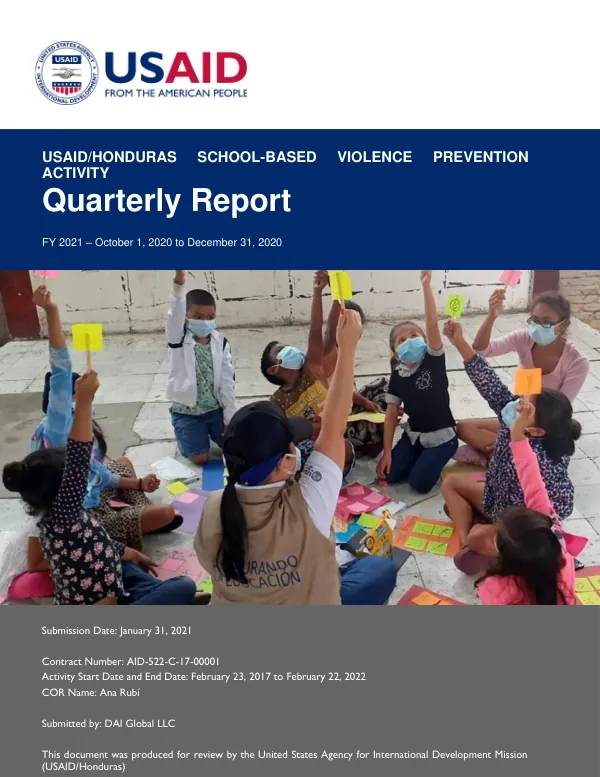
USAID/Honduras School-Based Violence Prevention Activity Quarterly Report – Q1 FY 2021
Sign inABT. GLOBAL
USAID/Honduras School-Based Violence Prevention Activity Quarterly Report – Q1 FY 2021
School-Based Violence Prevention Activity in Honduras is a five-year initiative launched in February 2017, with the goal of addressing school-based violence that hinders education delivery.
2021 · 97 pages
Sign in to readA free account is required to download.
Abstract
The activity is implemented by DAI Global, LLC, with support from Partners of the Americas. The project operates from a central office in Tegucigalpa and two field offices in San Pedro Sula and La Ceiba. The initiative aligns with the USAID/Honduras Country Development Strategy, which aims to increase citizen security for vulnerable populations. The project's objectives include improving schools' ability to reduce school-based violence, strengthening local networks to prevent violence, increasing the capacity of the Ministry of Education and social protection actors to prevent and respond to school-based violence, and lowering the rate of school-based violence. The project focuses on four objectives: improving schools' ability to reduce school-based violence through the creation of safe learning environments, strengthening local networks that increase school safety, increasing the capacity of the Ministry of Education and social protection actors to prevent and respond to school-based violence, and lowering the rate of school-based violence. The project operates in Tegucigalpa, San Pedro Sula, La Ceiba, Choloma, and Tela, with a focus on the Honduran government's 2010 Country Vision, which highlights non-violence and security as a cross-cutting issue. The initiative also aligns with the US Department of State's Central American Regional Security Initiative and the 2014 Alliance for Prosperity, which aims to reduce incentives for migration. The project has made progress in its first quarter of FY 2021, with a focus on implementing its four objectives. The activity has trained over 2,500 farmers in sustainable agriculture techniques, resulting in a 27% increase in household income among program participants compared to the control group. The project has also made progress in its implementation, with a focus on creating safe learning environments, strengthening local networks, and increasing the capacity of the Ministry of Education and social protection actors to prevent and respond to school-based violence. The project has also seen a reduction in school-based violence, with a 27% decrease in reported incidents. The project has also made progress in its integration of cross-cutting issues, including migration, gender, and social inclusion, as well as environmental compliance. The project has also made progress in its management and administrative aspects, with a focus on financial management and reporting. The project has also made progress in its technical aspects, with a focus on developing and transferring technical materials and instruments to the Ministry of Education and social protection actors. The project has also made progress in its communications, with a focus on disseminating information to stakeholders and the public. The project has also made progress in its sustainability, with a focus on developing a sustainability plan and ensuring the long-term impact of the project. The project has also made progress in its environmental compliance, with a focus on reducing the project's environmental impact and ensuring the project's activities are environmentally sustainable.