USAID DEC
Guide to Governance, Management, and Team Development: A Resource for Global Health Impact Investors
Sign inUNIVERSITAS DUKE
Guide to Governance, Management, and Team Development: A Resource for Global Health Impact Investors
The guide to governance, management, and team development for global health impact investors is a resource designed to help investors evaluate the organizational development characteristics of companies at different stages of growth.
3 pages
Sign in to readA free account is required to download.
Abstract
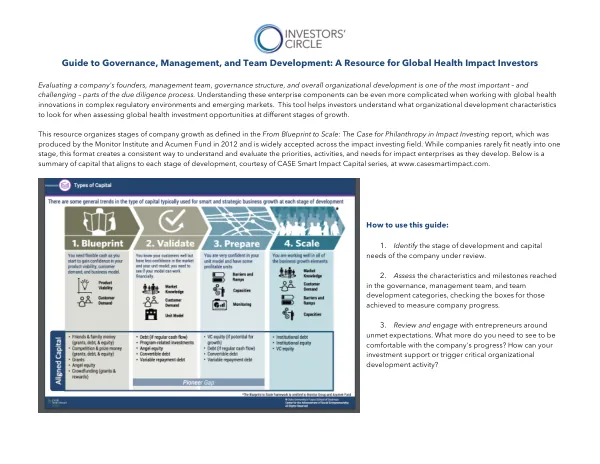
The tool organizes stages of company growth as defined in the From Blueprint to Scale: The Case for Philanthropy in Impact Investing report, which was produced by the Monitor Institute and Acumen Fund in 2012. This format creates a consistent way to understand and evaluate the priorities, activities, and needs for impact enterprises as they develop. The guide categorizes company growth into five stages: Blueprint, Validate, Prepare, Scale, and Governance. Each stage is associated with specific characteristics and milestones in governance, management team, and team development. For instance, in the Blueprint stage, founders show intent and commitment to governance strategy, and financials and initial Key Performance Indicators (KPIs) are identified and tracked. In the Validate stage, a Board of Directors and/or Advisory Board exists, and governance meeting and reporting structure is in place. The guide also outlines the characteristics of a well-functioning management team and team development at each stage. For example, in the Prepare stage, the company is beginning to fill the management team with next roles to hire, especially in finance/accounting/management to support physician CEOs. Founders show ability to attract quality employees and willingness to delegate, and founders' integrity incites trust in the caliber of team and team development strategy. In the Scale stage, the company has settled into appropriate roles, and key management team members have experience turnover but all roles are filled or final 1-2 positions are actively being filled. Understanding of strategic needs for scaling is covered by management team members, Board members, or consultants, and company culture, operating standards, and personnel policies are established and documented. The guide also highlights the importance of team development, including titles, responsibilities, and org chart fluidity, team members' high performance across responsibilities, and team understanding of social and cultural influences and behavioral dynamics. In the Governance stage, the Board of Directors includes industry and investor perspectives, and regular governance meeting and reporting systems are in place. The guide is produced as part of the Social Entrepreneurship Accelerator at Duke (SEAD), in collaboration with the Center for the Advancement of Social Entrepreneurship at Duke (CASE), Innovations in Healthcare, and Investors' Circle, and funded by USAID. SEAD brings together interdisciplinary partners through a coordinated effort across Duke University and leverages institutional relationships and networks to create an integrated global health social entrepreneurship hub for diverse stakeholders across the globe. The guide is designed to help investors understand what organizational development characteristics to look for when assessing global health investment opportunities at different stages of growth. By using this guide, investors can evaluate the priorities, activities, and needs for impact enterprises as they develop and make informed investment decisions.