RTI INTERNATIONAL
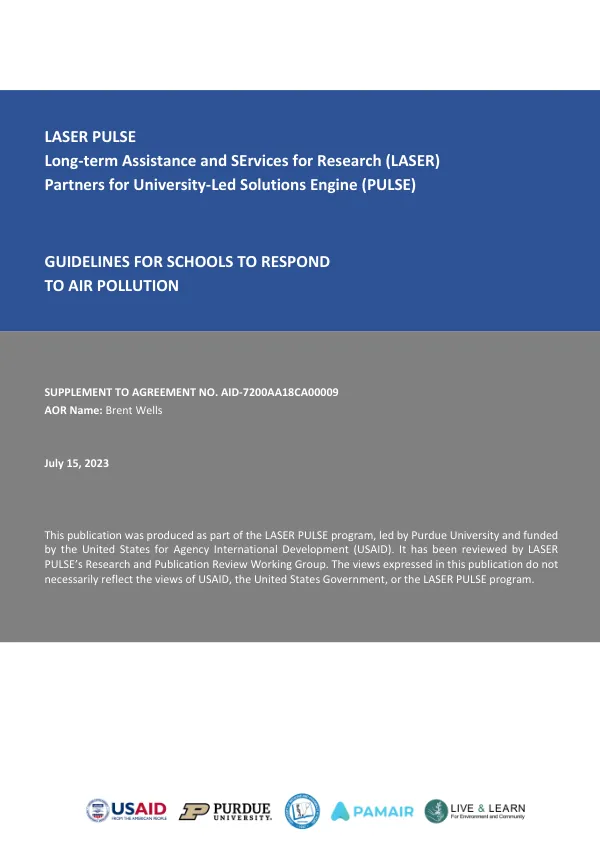
Guidelines for schools to respond to air pollution
The LASER PULSE program, a $70M initiative funded through USAID's Innovation, Technology, and Research Hub, delivers research-driven solutions to field-sourced development challenges in USAID partner countries.
2023 · 69 pages
Sign in to readA free account is required to download.
Abstract
The program is implemented by a consortium led by Purdue University, with core partners Catholic Relief Services, Indiana University, Makerere University, and the University of Notre Dame. The LASER PULSE program collaborates with USAID missions, bureaus, and independent offices, as well as other local stakeholders, to identify research needs for critical development challenges and fund and strengthen the capacity of researcher-practitioner teams to co-design solutions that translate into policy and practice. The project "Avoid the TRAP: Multi-sector collaboration between health, education and environment to minimize the impact of traffic-related air pollution (TRAP) on children in Ho Chi Minh City, Vietnam" was sponsored by Purdue University through the USAID-funded LASER PULSE program. The project aimed to develop evidence-based products to promote community engagement in protecting school children from TRAP. The project involved multi-sector collaboration (health, education, and environment) to achieve the following objectives and main products: establishing an innovative monitoring network for air quality around school areas, determining actual levels of TRAP exposure and potential links with respiratory health outcomes among school children, and developing and implementing effective approaches to disseminate information about TRAP and the best practices to reduce exposure. Key findings from the project survey on air pollution in an urban area of Vietnam include: 65% of children residing in homes burn incense daily, 43% living in households with smokers, with 75% of these smokers being the child's parents. Children who reside in the inner city have a higher incidence of wheezing symptoms compared to those living in the suburban areas, but children who frequently wear facemasks are less likely to suffer symptoms related to air pollution. Children who use open-air vehicles such as motorcycles or bicycles, spend more time on the road, or use charcoal/oil/kerosene stoves are more likely to suffer symptoms related to air pollution. The guidelines for schools to respond to air pollution were developed by the research team of the University of Medicine and Pharmacy at Ho Chi Minh City in cooperation with the Center of Live & Learn for Environment and Community. The guidelines aim to provide schools with practical solutions to respond to air pollution, including establishing an innovative monitoring network for air quality around school areas, determining actual levels of TRAP exposure and potential links with respiratory health outcomes among school children, and developing and implementing effective approaches to disseminate information about TRAP and the best practices to reduce exposure. The guidelines for schools to respond to air pollution include solutions such as establishing a system of air monitoring, training for schools, children, and parents to protect themselves from TRAP, and developing educational communication materials and activities. The guidelines also emphasize the importance of addressing the sources of indoor air pollution and relying solely on keeping children indoors may prove ineffective if the sources of indoor air pollution are not addressed.
Related documents